
Descripción
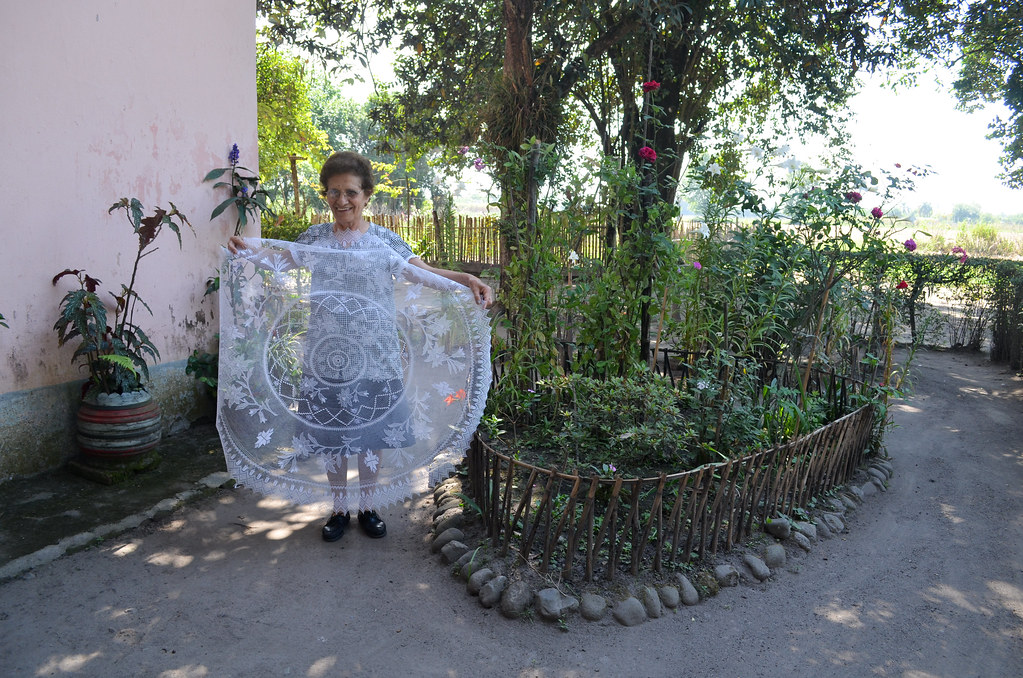
Las randas son labores de hilos con un lenguaje textil particular y notable que se realizan en la comunidad de El Cercado, provincia de Tucumán. Se trata de una red realizada manualmente en hilo de algodón, con la ayuda de una aguja y un palito guía. Como resultado se logra una red que se extiende posteriormente en un bastidor y se borda. A este tipo de encajes se los denomina randa labrada o bordada.
Las randas ingresaron al continente en el siglo XVI con las campañas de conquista y colonización europeas. Se utilizaban en terminaciones de indumentaria como cuellos, puños y bordes de todo tipo, y en piezas completas como mantas, mantillas, estolas y chales. Las randas fueron y son utilizadas en trajes eclesiásticos o como tapetes para ornamentos sagrados; también como tapetes en el hogar.
En el presente las randas son muy difundidas en la indumentaria y, de la mano de diseñadores de moda asociados a las artesanas, tienen nuevos usos y aplicaciones.
La elaboración de randas, en la actualidad es una técnica de la artesanía tradicional que se realiza exclusivamente en la localidad de El Cercado. El procedimiento se transmite de generación en generación entre las mujeres de la familia o entre vecinas. El grupo está compuesto por 45 artesanas que se reconocen entre sí como cultoras de este arte textil y portadoras de un patrimonio cultural inmaterial. Los saberes de las artesanas no sólo están vinculados a un procedimiento sino también a un repertorio de motivos y patrones propios como los denominados arrocitos, florcitas, ochitos, lluvia, panal de abeja, espiguita, esterilla, media margarita, etc.
Las artesanas conforman un colectivo que les permite afrontar pedidos en cantidad, producir de manera homogénea y mantener un estándar de precio.
ReferencesAmarilla, Roxana, “La Randa, intangible cultural heritage”, in Alejandra Mizrahi “RandAcerca”, Tucumán, Editorial Universidad Nacional de Tucuman EDUNT, 2019
Amarilla, Roxana, «La Randa de El Cercado, intangible cultural heritage. International Congress on Intangible Heritage. Progress and challenges. Buenos Aires. Center for Higher University Studies, 2017
Campano, Paulo 2015/9/16 “The randas of time. A model for safeguarding intangible cultural heritage” recovered fromhttps://www.youtube.com/watch?v=638A3XGzvOEEtcheverry, Delia “La Randa, networks that transcend time”, in Alejandra Mizrahi “RandAcerca”, Tucumán, Editorial Universidad Nacional de Tucuman EDUNT, 2019
Millán de Palavecino, Delia,“The old popular art of randa”Magazine of the National Institute of Tradition, Volume 1, Number 2, 1948, recovered at https://revistas.inapl.gob.ar/index.php/revista-int/article/view/607
Mizrahi, Alejandra, “The randa technique”, in Mizrahi and Trotteyn “Randa, Tucumán tradition and design in dialogue, Tucumán, Editorial Universidad Nacional de Tucuman EDUNT, Institute of Productive Development IDEP and Eugenio Flavio Virla Cultural Center, 2013
english
Randas
Randas are threadworks with a particular and remarkable textile expression. They are made in the community of El Cercado, in the province of Tucuman, and consist of a net made manually with cotton thread, a needle and a guide stick. The result is a net that is then stretched onto a frame and embroidered. This type of lace is called carved or embroidered randa.
Randas were introduced into the local culture of the continent in the 16th century, during the European conquest and subsequent colonization. They became prominent in the finishing touches of the clothes worn in these new colonies, and appeared on collars, cuffs, and borders of all kinds, and were further transformed into whole pieces, making up blankets,mantillas, stoles, and shawls. Randas have been and continue to be used in ecclesiastical vestments, serving as doilies for sacred ornaments. Additionally, in domestic settings, individuals crafted robust embroidered rugs from this distinctive form of needlework.
Nowadays, randas are widely used in clothing. Fashion designers associated with the traditional craftswomen have given new uses and applications to randas.
Randas are currently woven exclusively in the town of El Cercado, home to this traditional handicraft technique. The procedure is passed down from generation to generation among women either within their families or among female neighbors. The groups are made up of 45 craftswomen who recognize themselves as the makers of this textile art and the bearers of intangible cultural heritage. The craftswomen’s knowledge is not only linked to a procedure but also to a repertoire of motifs and patterns, such as the so-calledrice (little rice grains), little flowers (little flowers), ochitos (little eights), rain (rain), honeycomb (honeycomb), spikelet (little wheat spike), mat (little rush mat), half daisy (half daisy), etc.
Craftswomen form a collective that enables them to respond to large orders, produce homogeneously, and maintain a standard price.
Valoraciones
No hay valoraciones aún.