
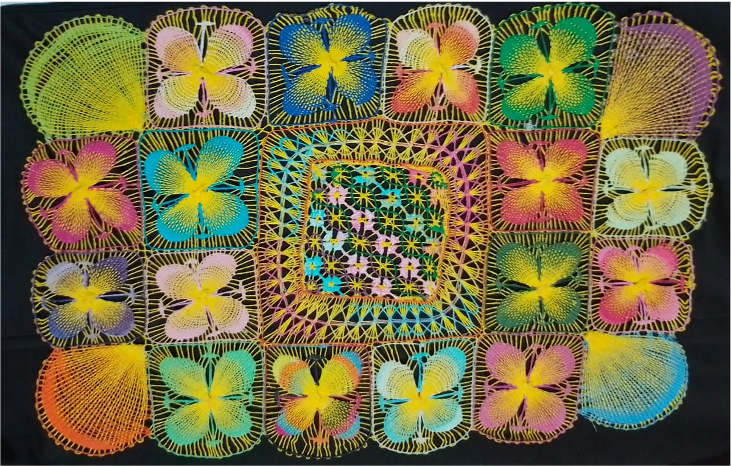
Ñandutí

Origin.The ñandutí is a needle lace originating from Tenerife, Spain, it was introduced during the conquest and spread throughout America. It is also known as Soles de Maracaibo. The same lace is recorded in Puebla, Mexico and is known as ñandutí.The name in Paraguay. Guarani word: ñandú-spider; ti-white, similar to spider web.Raw material:Spider threads of […]

Descripción

Origin.The ñandutí is a needle lace originating from Tenerife, Spain, it was introduced during the conquest and spread throughout America. It is also known as Soles de Maracaibo. The same lace is recorded in Puebla, Mexico and is known as ñandutí.The name in Paraguay. Guarani word: ñandú-spider; ti-white, similar to spider web.Raw material:Spider threads of a species that weaves gigantic nests in the treetops, with a rather woolly texture and ocher color. This ñandutí was made approximately until the 1960s. In Madagascar, spider thread is also made and they call it Madagascar lace *. In Carapeguá, ñandutí was produced with cotton, with fiber from the coconut cluster (mbokaja) and karaguata.Technique. The samplers are prepared on cloth and the warp is done radially in most cases. In Carapeguá, the warp is made freely without fabric, the threads are held by the frame, real Spanish soles were also made.Name of the samplers. The artisans give names to the designs related to their environment such as: brick; aguape, camalote; aguara rugúai, foxtail; scorpion; altars and lanterns; amambai, ferns; aña juru, mouth of the devil; arai, clouds; arapaho (starch cookie); arasa poty, guava flower; avati poty, corn flower; jasmine poty, jasmine flower; bottle; mburukuja poty, passion flower; pira kostilla, fish rib; karape star, small star.

Production.It is currently manufactured in Itaugua and Pirayu. In the past, it was made with fine white thread to make mantillas, shawls, decorations for altars, appliqués for dresses, blouses or skirts. Today the ñandutí with fine thread is very rare, there is the white one with thick thread, there is variety and quantity of ñandutís with different colors for domestic decorations, appliqués, but the greatest demand is for the making of skirts and robes or typói especially for popular dances.

English

Ñandutí lace

Origin.The ñandutí is a needle lace originating from Tenerife, Spain. It was introduced during the conquest and spread throughout America. It is also known as Soles de Maracaibo. The same lace is recorded in Puebla, Mexico and is known as ñandutí.The name in Paraguay. Guarani word: rhea-spider; ti-white, similar to spider weave.raw material: spider threads of a species that weaves gigantic nests in the treetops, rather woolly in texture and ocher in colour. This rhea was produced until about the 1960s. In Madagascar, spider thread is also produced and is called Madagascar lace. In Carapeguá, it was produced with cotton, with fiber from the coconut bunch (mbokaja) and from karaguata.Technique. The samplers are prepared on cloth and the warp is made radially in most cases. In Carapeguá, the warp is made freely without cloth, the threads are held by the frame, and real Spanish soles were also made.Naming of the designs. The craftswomen give names to the designs related to their environment such as: ‘brick’; ‘aguape’, ‘camalote’; ‘aguara rugúai’, ‘fox tail’; ‘scorpion’, altars and lanterns; ‘amambai’, ferns; ‘aña juru’, devil’s mouth; ‘arai’, clouds; ‘arapaho’ (starch biscuit); ‘arasa poty, guava flower; avati poty, corn flower; jasmine poty, jasmine flower; bottle; mburukuja poty, passion flower; pira costilla, fish rib; “karape star”, small star.Production. It is currently made in Itaugua and Pirayu. In the past, the fine white thread was used to make blankets, shawls, ornaments for altars, appliqués for dresses, blouses or skirts. Nowadays the ñandutí with fine thread is very scarce. There is white with thick thread, There is a variety and quantity of ñandutíes with different colors for domestic ornaments, ‘appliques’, but the greatest demand is for the making of skirts and gowns or typói especially for popular dances.

Valoraciones

No hay valoraciones aún.

Sé el primero en valorar “Ñandutí”

Tu dirección de correo electrónico no será publicada. Los campos obligatorios están marcados con *

Descripción

Origin.The ñandutí is a needle lace originating from Tenerife, Spain, it was introduced during the conquest and spread throughout America. It is also known as Soles de Maracaibo. The same lace is recorded in Puebla, Mexico and is known as ñandutí.The name in Paraguay. Guarani word: ñandú-spider; ti-white, similar to spider web.Raw material:Spider threads of a species that weaves gigantic nests in the treetops, with a rather woolly texture and ocher color. This ñandutí was made approximately until the 1960s. In Madagascar, spider thread is also made and they call it Madagascar lace *. In Carapeguá, ñandutí was produced with cotton, with fiber from the coconut cluster (mbokaja) and karaguata.Technique. The samplers are prepared on cloth and the warp is done radially in most cases. In Carapeguá, the warp is made freely without fabric, the threads are held by the frame, real Spanish soles were also made.Name of the samplers. The artisans give names to the designs related to their environment such as: brick; aguape, camalote; aguara rugúai, foxtail; scorpion; altars and lanterns; amambai, ferns; aña juru, mouth of the devil; arai, clouds; arapaho (starch cookie); arasa poty, guava flower; avati poty, corn flower; jasmine poty, jasmine flower; bottle; mburukuja poty, passion flower; pira kostilla, fish rib; karape star, small star.

Production.It is currently manufactured in Itaugua and Pirayu. In the past, it was made with fine white thread to make mantillas, shawls, decorations for altars, appliqués for dresses, blouses or skirts. Today the ñandutí with fine thread is very rare, there is the white one with thick thread, there is variety and quantity of ñandutís with different colors for domestic decorations, appliqués, but the greatest demand is for the making of skirts and robes or typói especially for popular dances.

English

Ñandutí lace

Origin.The ñandutí is a needle lace originating from Tenerife, Spain. It was introduced during the conquest and spread throughout America. It is also known as Soles de Maracaibo. The same lace is recorded in Puebla, Mexico and is known as ñandutí.The name in Paraguay. Guarani word: rhea-spider; ti-white, similar to spider weave.raw material: spider threads of a species that weaves gigantic nests in the treetops, rather woolly in texture and ocher in colour. This rhea was produced until about the 1960s. In Madagascar, spider thread is also produced and is called Madagascar lace. In Carapeguá, it was produced with cotton, with fiber from the coconut bunch (mbokaja) and from karaguata.Technique. The samplers are prepared on cloth and the warp is made radially in most cases. In Carapeguá, the warp is made freely without cloth, the threads are held by the frame, and real Spanish soles were also made.Naming of the designs. The craftswomen give names to the designs related to their environment such as: ‘brick’; ‘aguape’, ‘camalote’; ‘aguara rugúai’, ‘fox tail’; ‘scorpion’, altars and lanterns; ‘amambai’, ferns; ‘aña juru’, devil’s mouth; ‘arai’, clouds; ‘arapaho’ (starch biscuit); ‘arasa poty, guava flower; avati poty, corn flower; jasmine poty, jasmine flower; bottle; mburukuja poty, passion flower; pira costilla, fish rib; “karape star”, small star.Production. It is currently made in Itaugua and Pirayu. In the past, the fine white thread was used to make blankets, shawls, ornaments for altars, appliqués for dresses, blouses or skirts. Nowadays the ñandutí with fine thread is very scarce. There is white with thick thread, There is a variety and quantity of ñandutíes with different colors for domestic ornaments, ‘appliques’, but the greatest demand is for the making of skirts and gowns or typói especially for popular dances.

Valoraciones

No hay valoraciones aún.

Sé el primero en valorar “Ñandutí”

Tu dirección de correo electrónico no será publicada. Los campos obligatorios están marcados con *

Descripción

Origin.The ñandutí is a needle lace originating from Tenerife, Spain, it was introduced during the conquest and spread throughout America. It is also known as Soles de Maracaibo. The same lace is recorded in Puebla, Mexico and is known as ñandutí.The name in Paraguay. Guarani word: ñandú-spider; ti-white, similar to spider web.Raw material:Spider threads of a species that weaves gigantic nests in the treetops, with a rather woolly texture and ocher color. This ñandutí was made approximately until the 1960s. In Madagascar, spider thread is also made and they call it Madagascar lace *. In Carapeguá, ñandutí was produced with cotton, with fiber from the coconut cluster (mbokaja) and karaguata.Technique. The samplers are prepared on cloth and the warp is done radially in most cases. In Carapeguá, the warp is made freely without fabric, the threads are held by the frame, real Spanish soles were also made.Name of the samplers. The artisans give names to the designs related to their environment such as: brick; aguape, camalote; aguara rugúai, foxtail; scorpion; altars and lanterns; amambai, ferns; aña juru, mouth of the devil; arai, clouds; arapaho (starch cookie); arasa poty, guava flower; avati poty, corn flower; jasmine poty, jasmine flower; bottle; mburukuja poty, passion flower; pira kostilla, fish rib; karape star, small star.

Production.It is currently manufactured in Itaugua and Pirayu. In the past, it was made with fine white thread to make mantillas, shawls, decorations for altars, appliqués for dresses, blouses or skirts. Today the ñandutí with fine thread is very rare, there is the white one with thick thread, there is variety and quantity of ñandutís with different colors for domestic decorations, appliqués, but the greatest demand is for the making of skirts and robes or typói especially for popular dances.

English

Ñandutí lace

Origin.The ñandutí is a needle lace originating from Tenerife, Spain. It was introduced during the conquest and spread throughout America. It is also known as Soles de Maracaibo. The same lace is recorded in Puebla, Mexico and is known as ñandutí.The name in Paraguay. Guarani word: rhea-spider; ti-white, similar to spider weave.raw material: spider threads of a species that weaves gigantic nests in the treetops, rather woolly in texture and ocher in colour. This rhea was produced until about the 1960s. In Madagascar, spider thread is also produced and is called Madagascar lace. In Carapeguá, it was produced with cotton, with fiber from the coconut bunch (mbokaja) and from karaguata.Technique. The samplers are prepared on cloth and the warp is made radially in most cases. In Carapeguá, the warp is made freely without cloth, the threads are held by the frame, and real Spanish soles were also made.Naming of the designs. The craftswomen give names to the designs related to their environment such as: ‘brick’; ‘aguape’, ‘camalote’; ‘aguara rugúai’, ‘fox tail’; ‘scorpion’, altars and lanterns; ‘amambai’, ferns; ‘aña juru’, devil’s mouth; ‘arai’, clouds; ‘arapaho’ (starch biscuit); ‘arasa poty, guava flower; avati poty, corn flower; jasmine poty, jasmine flower; bottle; mburukuja poty, passion flower; pira costilla, fish rib; “karape star”, small star.Production. It is currently made in Itaugua and Pirayu. In the past, the fine white thread was used to make blankets, shawls, ornaments for altars, appliqués for dresses, blouses or skirts. Nowadays the ñandutí with fine thread is very scarce. There is white with thick thread, There is a variety and quantity of ñandutíes with different colors for domestic ornaments, ‘appliques’, but the greatest demand is for the making of skirts and gowns or typói especially for popular dances.

Valoraciones

No hay valoraciones aún.

Sé el primero en valorar “Ñandutí”

Tu dirección de correo electrónico no será publicada. Los campos obligatorios están marcados con *

Descripción

Origin.The ñandutí is a needle lace originating from Tenerife, Spain, it was introduced during the conquest and spread throughout America. It is also known as Soles de Maracaibo. The same lace is recorded in Puebla, Mexico and is known as ñandutí.The name in Paraguay. Guarani word: ñandú-spider; ti-white, similar to spider web.Raw material:Spider threads of a species that weaves gigantic nests in the treetops, with a rather woolly texture and ocher color. This ñandutí was made approximately until the 1960s. In Madagascar, spider thread is also made and they call it Madagascar lace *. In Carapeguá, ñandutí was produced with cotton, with fiber from the coconut cluster (mbokaja) and karaguata.Technique. The samplers are prepared on cloth and the warp is done radially in most cases. In Carapeguá, the warp is made freely without fabric, the threads are held by the frame, real Spanish soles were also made.Name of the samplers. The artisans give names to the designs related to their environment such as: brick; aguape, camalote; aguara rugúai, foxtail; scorpion; altars and lanterns; amambai, ferns; aña juru, mouth of the devil; arai, clouds; arapaho (starch cookie); arasa poty, guava flower; avati poty, corn flower; jasmine poty, jasmine flower; bottle; mburukuja poty, passion flower; pira kostilla, fish rib; karape star, small star.

Production.It is currently manufactured in Itaugua and Pirayu. In the past, it was made with fine white thread to make mantillas, shawls, decorations for altars, appliqués for dresses, blouses or skirts. Today the ñandutí with fine thread is very rare, there is the white one with thick thread, there is variety and quantity of ñandutís with different colors for domestic decorations, appliqués, but the greatest demand is for the making of skirts and robes or typói especially for popular dances.

English

Ñandutí lace

Origin.The ñandutí is a needle lace originating from Tenerife, Spain. It was introduced during the conquest and spread throughout America. It is also known as Soles de Maracaibo. The same lace is recorded in Puebla, Mexico and is known as ñandutí.The name in Paraguay. Guarani word: rhea-spider; ti-white, similar to spider weave.raw material: spider threads of a species that weaves gigantic nests in the treetops, rather woolly in texture and ocher in colour. This rhea was produced until about the 1960s. In Madagascar, spider thread is also produced and is called Madagascar lace. In Carapeguá, it was produced with cotton, with fiber from the coconut bunch (mbokaja) and from karaguata.Technique. The samplers are prepared on cloth and the warp is made radially in most cases. In Carapeguá, the warp is made freely without cloth, the threads are held by the frame, and real Spanish soles were also made.Naming of the designs. The craftswomen give names to the designs related to their environment such as: ‘brick’; ‘aguape’, ‘camalote’; ‘aguara rugúai’, ‘fox tail’; ‘scorpion’, altars and lanterns; ‘amambai’, ferns; ‘aña juru’, devil’s mouth; ‘arai’, clouds; ‘arapaho’ (starch biscuit); ‘arasa poty, guava flower; avati poty, corn flower; jasmine poty, jasmine flower; bottle; mburukuja poty, passion flower; pira costilla, fish rib; “karape star”, small star.Production. It is currently made in Itaugua and Pirayu. In the past, the fine white thread was used to make blankets, shawls, ornaments for altars, appliqués for dresses, blouses or skirts. Nowadays the ñandutí with fine thread is very scarce. There is white with thick thread, There is a variety and quantity of ñandutíes with different colors for domestic ornaments, ‘appliques’, but the greatest demand is for the making of skirts and gowns or typói especially for popular dances.

Valoraciones

No hay valoraciones aún.

Sé el primero en valorar “Ñandutí”

Tu dirección de correo electrónico no será publicada. Los campos obligatorios están marcados con *

Descripción

Origin.The ñandutí is a needle lace originating from Tenerife, Spain, it was introduced during the conquest and spread throughout America. It is also known as Soles de Maracaibo. The same lace is recorded in Puebla, Mexico and is known as ñandutí.The name in Paraguay. Guarani word: ñandú-spider; ti-white, similar to spider web.Raw material:Spider threads of a species that weaves gigantic nests in the treetops, with a rather woolly texture and ocher color. This ñandutí was made approximately until the 1960s. In Madagascar, spider thread is also made and they call it Madagascar lace *. In Carapeguá, ñandutí was produced with cotton, with fiber from the coconut cluster (mbokaja) and karaguata.Technique. The samplers are prepared on cloth and the warp is done radially in most cases. In Carapeguá, the warp is made freely without fabric, the threads are held by the frame, real Spanish soles were also made.Name of the samplers. The artisans give names to the designs related to their environment such as: brick; aguape, camalote; aguara rugúai, foxtail; scorpion; altars and lanterns; amambai, ferns; aña juru, mouth of the devil; arai, clouds; arapaho (starch cookie); arasa poty, guava flower; avati poty, corn flower; jasmine poty, jasmine flower; bottle; mburukuja poty, passion flower; pira kostilla, fish rib; karape star, small star.

Production.It is currently manufactured in Itaugua and Pirayu. In the past, it was made with fine white thread to make mantillas, shawls, decorations for altars, appliqués for dresses, blouses or skirts. Today the ñandutí with fine thread is very rare, there is the white one with thick thread, there is variety and quantity of ñandutís with different colors for domestic decorations, appliqués, but the greatest demand is for the making of skirts and robes or typói especially for popular dances.

English

Ñandutí lace

Origin.The ñandutí is a needle lace originating from Tenerife, Spain. It was introduced during the conquest and spread throughout America. It is also known as Soles de Maracaibo. The same lace is recorded in Puebla, Mexico and is known as ñandutí.The name in Paraguay. Guarani word: rhea-spider; ti-white, similar to spider weave.raw material: spider threads of a species that weaves gigantic nests in the treetops, rather woolly in texture and ocher in colour. This rhea was produced until about the 1960s. In Madagascar, spider thread is also produced and is called Madagascar lace. In Carapeguá, it was produced with cotton, with fiber from the coconut bunch (mbokaja) and from karaguata.Technique. The samplers are prepared on cloth and the warp is made radially in most cases. In Carapeguá, the warp is made freely without cloth, the threads are held by the frame, and real Spanish soles were also made.Naming of the designs. The craftswomen give names to the designs related to their environment such as: ‘brick’; ‘aguape’, ‘camalote’; ‘aguara rugúai’, ‘fox tail’; ‘scorpion’, altars and lanterns; ‘amambai’, ferns; ‘aña juru’, devil’s mouth; ‘arai’, clouds; ‘arapaho’ (starch biscuit); ‘arasa poty, guava flower; avati poty, corn flower; jasmine poty, jasmine flower; bottle; mburukuja poty, passion flower; pira costilla, fish rib; “karape star”, small star.Production. It is currently made in Itaugua and Pirayu. In the past, the fine white thread was used to make blankets, shawls, ornaments for altars, appliqués for dresses, blouses or skirts. Nowadays the ñandutí with fine thread is very scarce. There is white with thick thread, There is a variety and quantity of ñandutíes with different colors for domestic ornaments, ‘appliques’, but the greatest demand is for the making of skirts and gowns or typói especially for popular dances.

Valoraciones

No hay valoraciones aún.

Sé el primero en valorar “Ñandutí”

Tu dirección de correo electrónico no será publicada. Los campos obligatorios están marcados con *

Descripción

Origen. El ñandutí es un encaje de aguja originario de Tenerife, España, fue introducido durante la conquista y se extendió por toda América. Se lo conoce también como Soles de Maracaibo. Se registra en Puebla, México el mismo encaje y se conoce con el nombre de ñandutí.

El nombre en Paraguay. Palabra guaraní: ñandú-araña; ti-blanco, parecido al tejido de araña.

Materia Prima: Hilos de araña de una especie que teje nidos gigantescos en las copas de árboles, de textura más bien lanosa y color ocre. Este ñandutí se llegó a elaborar aproximadamente hasta la década del 1960. En Madagascar, también se hace hilo de una araña y lo llaman encaje de Madagascar *. En Carapeguá se producía ñandutí con algodón, con fibra del racimo de coco (mbokaja) y de karaguata.

Técnica. Los dechados se preparan sobre tela y la urdimbre se realiza en forma radial en la mayoría de los casos. En Carapeguá, la urdimbre se elabora en forma libre sin tela, los hilos se sostienen por el bastidor, también se fabricaban verdaderos soles de españoles.

Denominación de los dechados. Las artesanas dan nombres a los diseños relacionados con su entorno cómo: ladrillo; aguape, camalote; aguara rugúai, cola de zorro; alacrán; altares y faroles; amambái, helechos; aña juru, boca del diablo; arai, nubes; arapaho (galletita de almidón); arasa poty, flor de guayabo; avati poty, flor del maíz; jazmín poty, flor de jazmín; botella; mburukuja poty, flor de pasionaria; pira kostilla, costilla de pescado; estrella karape, estrella pequeña.

Producción. Actualmente se fabrica en Itaugua y Pirayu. Antiguamente se elaboraba con hilo blanco fino se hacían mantillas, chales, adornos para los altares, apliques para vestidos, blusas o polleras. Hoy día es muy escaso el ñandutí con hilo fino, existe el blanco con hilo grueso, existe variedad y en cantidad los ñandutíes con colores diversos para los adornos doméstico, apliques, pero la mayor demanda es para la confección de polleras y batas o typói especialmente para los bailes populares.

English

Ñandutí lace

Origin. The ñandutí is a needle lace originating from Tenerife, Spain. It was introduced during the conquest and spread throughout America. It is also known as Soles de Maracaibo. The same lace is recorded in Puebla, Mexico and is known as ñandutí.

The name in Paraguay. Guarani word: ñandú-araña; ti-blanco, similar to spider weave.

Raw material: spider threads of a species that weaves gigantic nests in the treetops, rather woolly in texture and ochre in colour. This rhea was produced until about the 1960s. In Madagascar, spider thread is also produced and is called Madagascar lace. In Carapeguá, it was produced with cotton, with fibre from the coconut bunch (mbokaja) and from karaguata.

Technique. The samplers are prepared on cloth and the warp is made radially in most cases. In Carapeguá, the warp is made freely without cloth, the threads are held by the frame, and real Spanish soles were also made.

Naming of the designs. The craftswomen give names to the designs related to their environment such as: ‘brick’; ‘aguape’, ‘camalote’; ‘aguara rugúai’, ‘fox tail’; ‘alacrán’, altars and lanterns; ‘amambái’, ferns; ‘aña juru’, devil’s mouth; ‘arai’, clouds; ‘arapaho’ (starch biscuit); ‘arasa poty, guava flower; avati poty, corn flower; jazmin poty, jasmine flower; bottle; mburukuja poty, passion flower; pira kostilla, fish rib; “estrella karape”, small star.

Production. It is currently made in Itaugua and Pirayu. In the past, the fine white thread was used to make blankets, shawls, ornaments for altars, appliqués for dresses, blouses or skirts. Nowadays the ñandutí with fine thread is very scarce. There is white with thick thread, There is a variety and quantity of ñandutíes with different colours for domestic ornaments, ‘appliques’, but the greatest demand is for the making of skirts and gowns or typói especially for popular dances.

Valoraciones

No hay valoraciones aún.

Sé el primero en valorar “Ñandutí”

Tu dirección de correo electrónico no será publicada. Los campos obligatorios están marcados con *