
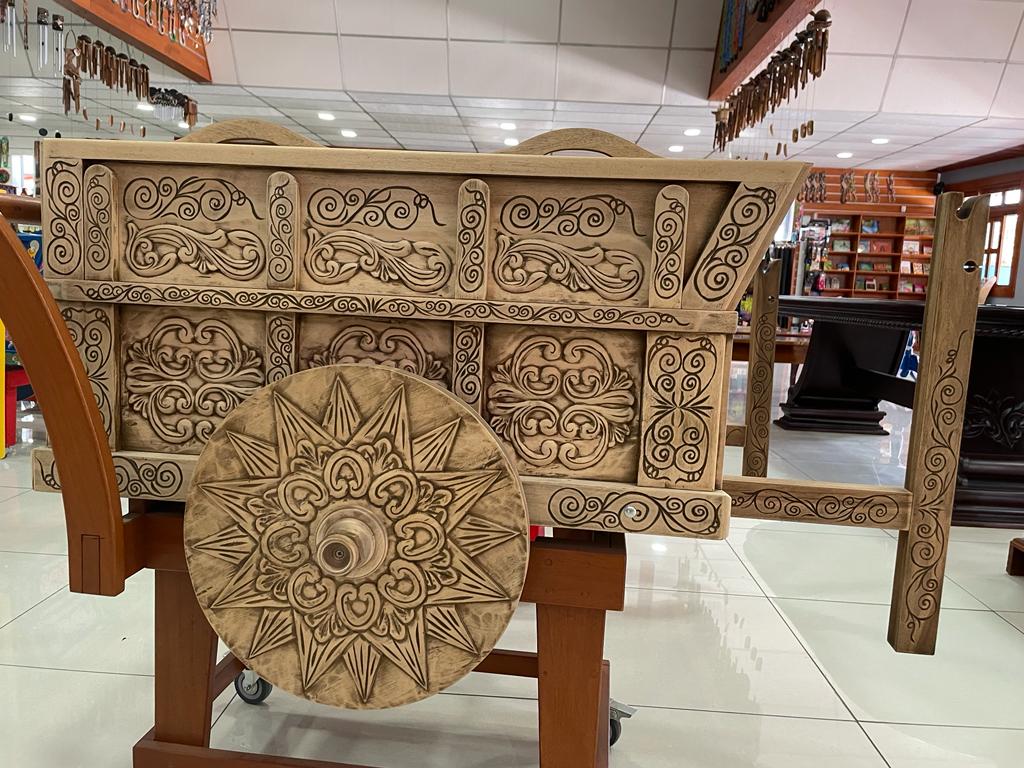
Painted Wagon

En Costa Rica, la elaboración de artesanías en madera es muy común; sin embargo, las comunidades  de Sarchí y Palmares en la provincia de Alajuela, son reconocidas por el oficio de ebanistería ligada a la producción mueblera. Sin embargo, Sarchí destaca por la producción de artesanías de calidad,  en especial la tradicional carreta en madera […]

Descripción

En Costa Rica, la elaboración de artesanías en madera es muy común; sin embargo, las comunidades  de Sarchí y Palmares en la provincia de Alajuela, son reconocidas por el oficio de ebanistería ligada a la producción mueblera. Sin embargo, Sarchí destaca por la producción de artesanías de calidad,  en especial la tradicional carreta en madera de bueyes pintada. Esta artesanía, se caracteriza por  ser muy colorida y llamativa, cada una tiene de 10 a 15 colores diferentes combinados y plasmados  en figuras de orlas (colochos sarchiseños) y pistilos (flores), estrellas o figuras puntiagudas.

La decoración con pintura de la carreta en la comunidad de Sarchí data de 1920; relacionada al  nacimiento en esta comunidad de la Fábrica de Carretas Chaverri (desde 1903) y la Fábrica de  Carretas Eloy Alfaro (desde 1920), ambas aún activas.

La carreta tradicional, se inspiró en las carretas de Andalucía España, donde tenían otro diseño y  estructura en mimbre y se utilizaban sobre todo para transportar uvas. Como artesanía, se elabora  en diferentes tamaños y diseños de pintura, inspirada en la tradicional y original carreta de bueyes  costarricense, que se utilizaba en el país desde mediados del siglo XIX para el transporte de  productos, sobre todo del café y de las familias en zonas rurales (sinónimo de estatus).

Para la fabricación de la carreta tradicional a tamaño original, se requieren: madera, hierro, pintura  y fuego para calentar los aros de hierro y lograr ensamblar o armar las ruedas, de una sola pieza de  madera, la de tres piezas o la de 16 cuñas de madera.

Como artesanías, se producen carretas desde tamaños muy pequeños tipo suvenir de 2” hasta la tipo bar de 45”; y para su elaboración se requieren: 1)Madera: cedro, pochote o laurel; más  recientemente también se utiliza la melina, jaul, playwood y fibran hidrófugo para los tableros. 2)Pegamento y cola para armar parales. 3)Tornillos de carrocería con rosca para ensamble.

4)Gasolina o varsol como diluyentes. 5)Brochas y pinceles. 6)Pinturas de aceite de dos tipos: la base de secado rápido y la de secado lento.

Los oficios para la elaboración son: ebanista y pintor. Las técnicas son: trazado, cortado, cepillado,  lijado, armado, ensamblado. Para la pintada lo primero es escoger uno de los 7 colores base: blanco,  negro, azul, amarillo, rojo y naranja (las más vendidas 85%) y verde bosque. Luego el relleno o diseño  a pintar: 1)Colocho principal, cacho o relleno, flores, sombreado. 2)La hiladilla: para separar los  colores de todos los elementos. 3)Los adornos: encaje, pinos, pistilos, puntitos, cucarachas, otros.  En promedio se usan de 10 a 15 colores en cada carreta y su aplicación e intensidad depende del  estilo personal del pintor y de la escuela a la que pertenezca: a)Chaverri que utiliza colores pasteles.  b)Alfaro utiliza colores más intensos. c)Junior Chavarría utiliza colores aún más intensos.

La carreta de bueyes, fue declarada en 1988 como símbolo nacional y se celebra los 22 de marzo,  con desfiles de carretas. La tradición de pintar la carreta fue declarada Patrimonio Cultural de la  Humanidad por la UNESCO en el año 1995 y en 2008 la tradición del Boyeo y la Carreta fue inscrita  en la Lista Representativa del Patrimonio Cultural Inmaterial de la Humanidad (proclamado  originalmente en 2005).

En el parque central se Sarchí, se expone la carreta y yugo más grande del mundo (15 metros de largo y pesa casi 2 toneladas), incluida en el libro de Récord Guinness en el 2006, fabricada y  decorada por artesanos locales. A nivel comercial, podrá comprar esta artesanía en talleres y tiendas

locales, o en tiendas ubicadas en los centros turísticos del país. Todas las carretas, son desarmables  y se venden empacadas con sus respectivas instrucciones y guías de armado.

En la actualidad se identifican 15 artesanos relacionados a elaboración y decoración de la carreta en  Sarchí. Algunos de los maestros artesanos en fabricación son: Egidio Alpizar Chaverri, Fernando  Alfaro, Uriel Alfaro (herraje de la carreta) y Martín Alfaro. Y en decoración-pintores son: Carlos  Chaverri, Manuel Chaverri, Félix Chavarría, Rolando Alvarado, Fernando Alpizar, Edgar Alpizar,  Francisco Alfaro, Wilson Bonilla. Dos de ellos ya cuentan con el Sello COSTA RICA ARTESANAL.

english

The Traditional Painted Oxcart of SarchiIn Costa Rica, the elaboration of wooden handicrafts is very common and the communities of «Sarchi» and «Palmares» in the province of «Alajuela», are well known for the craft of cabinetmaking linked to the production of furniture. Sarchí stands out for the production of quality handicrafts, especially the traditional painted oxcart. This handicraft is characterized by being very colorful and eye-catching, each one has 10 to 15 different colors with figures of «colochos sarchiseños» and «flores», stars, borders and pointed figures.

The decoration dates back to 1920 and is related to the birth in this community of the «Fábrica de Carretas Chaverri» (from 1903) and the «Fábrica de Carretas Eloy Alfaro» (from 1920), both still active. The traditional cart was inspired by those of Andalusia and Spain, where they had a different design and wicker structure and were mainly used to transport grapes.

As a handicraft, it is made in different sizes and has been used in the country since the middle of the 19th century for the transportation of goods, especially coffee and for families in rural areas (synonymous with status). To make the traditional cart in its original size, wood, iron, paint and fire are required to heat the iron hoops and assemble the wheels, whether they are made of a single piece of wood, three pieces or 16 wooden wedges.

As handicrafts, carts are produced from very small 2″ souvenir type sizes to 45″ bar type; and for their elaboration, the following are required: 1) Wood: cedar, pochote or laurel; more recently melina, cage, plywood and fiber for the boards are also used. 2.-Glue and glue. 3.-Screws for bodywork. 4.-Gasoline as a thinner. 5.-Broaches and paintbrushes. 6) Oil paints of two types: fast-drying and slow-drying base. The trades for the production are: cabinetmaker and painter. The techniques are: tracing, cutting, brushing, sanding, assembling, assembling. For painting, the first thing to do is to choose one of the 7 base colors: white, black, blue, yellow, red and orange and forest green. Then the filling or design to be painted: 1.-Main cologne, filling, flowers, shading. 2.-The yarn: to separate the colors of all the elements. 3.-The decorations: lace, pins, pistils, dots, among others.  On average 10 to 15 colors are used in each oxcart and their application and intensity depends on the personal style of the painter and the school to which he belongs: a) Chaverri uses pastel colors. b) Alfaro uses more intense colors. c) Junior Chavarría uses even more intense colors.

The cart was declared a national symbol in 1988 and is celebrated on March 22, with parades of carts. The tradition of painting the oxcart was declared World Cultural Heritage by UNESCO in 1995 and in 2008 the tradition of the Boyeo and the Oxcart was inscribed on the Representative List of the Intangible Cultural Heritage of Humanity (originally proclaimed in 2005).

In the central park of Sarchí, the largest cart and yoke in the world (15 meters long and weighing almost 2 tons), included in the Guinness Book of Records in 2006, is on display, made and decorated by local artisans. Commercially, you can buy this handicraft in local workshops and shops, or in shops located in the tourist centers of the country. All the carts can be disassembled and are sold packaged with their respective instructions and assembly guides. At present, 15 artisans have been identified in Sarchí who are involved in the elaboration and decoration of the cart. Some of the master artisans involved are: Egidio Alpizar Chaverri, Fernando Alfaro, Uriel Alfaro (ironwork of the cart) and Martín Alfaro. And in decoration-painters are: Carlos Chaverri, Manuel Chaverri, Félix Chavarría, Rolando Alvarado, Fernando Alpizar, Edgar Alpizar, Francisco Alfaro, Wilson Bonilla. Two of them already have the COSTA RICA ARTESANAL Seal.

Valoraciones

No hay valoraciones aún.

Sé el primero en valorar “Painted Wagon”

Tu dirección de correo electrónico no será publicada. Los campos obligatorios están marcados con *

Descripción

En Costa Rica, la elaboración de artesanías en madera es muy común; sin embargo, las comunidades  de Sarchí y Palmares en la provincia de Alajuela, son reconocidas por el oficio de ebanistería ligada a la producción mueblera. Sin embargo, Sarchí destaca por la producción de artesanías de calidad,  en especial la tradicional carreta en madera de bueyes pintada. Esta artesanía, se caracteriza por  ser muy colorida y llamativa, cada una tiene de 10 a 15 colores diferentes combinados y plasmados  en figuras de orlas (colochos sarchiseños) y pistilos (flores), estrellas o figuras puntiagudas.

La decoración con pintura de la carreta en la comunidad de Sarchí data de 1920; relacionada al  nacimiento en esta comunidad de la Fábrica de Carretas Chaverri (desde 1903) y la Fábrica de  Carretas Eloy Alfaro (desde 1920), ambas aún activas.

La carreta tradicional, se inspiró en las carretas de Andalucía España, donde tenían otro diseño y  estructura en mimbre y se utilizaban sobre todo para transportar uvas. Como artesanía, se elabora  en diferentes tamaños y diseños de pintura, inspirada en la tradicional y original carreta de bueyes  costarricense, que se utilizaba en el país desde mediados del siglo XIX para el transporte de  productos, sobre todo del café y de las familias en zonas rurales (sinónimo de estatus).

Para la fabricación de la carreta tradicional a tamaño original, se requieren: madera, hierro, pintura  y fuego para calentar los aros de hierro y lograr ensamblar o armar las ruedas, de una sola pieza de  madera, la de tres piezas o la de 16 cuñas de madera.

Como artesanías, se producen carretas desde tamaños muy pequeños tipo suvenir de 2” hasta la tipo bar de 45”; y para su elaboración se requieren: 1)Madera: cedro, pochote o laurel; más  recientemente también se utiliza la melina, jaul, playwood y fibran hidrófugo para los tableros. 2)Pegamento y cola para armar parales. 3)Tornillos de carrocería con rosca para ensamble.

4)Gasolina o varsol como diluyentes. 5)Brochas y pinceles. 6)Pinturas de aceite de dos tipos: la base de secado rápido y la de secado lento.

Los oficios para la elaboración son: ebanista y pintor. Las técnicas son: trazado, cortado, cepillado,  lijado, armado, ensamblado. Para la pintada lo primero es escoger uno de los 7 colores base: blanco,  negro, azul, amarillo, rojo y naranja (las más vendidas 85%) y verde bosque. Luego el relleno o diseño  a pintar: 1)Colocho principal, cacho o relleno, flores, sombreado. 2)La hiladilla: para separar los  colores de todos los elementos. 3)Los adornos: encaje, pinos, pistilos, puntitos, cucarachas, otros.  En promedio se usan de 10 a 15 colores en cada carreta y su aplicación e intensidad depende del  estilo personal del pintor y de la escuela a la que pertenezca: a)Chaverri que utiliza colores pasteles.  b)Alfaro utiliza colores más intensos. c)Junior Chavarría utiliza colores aún más intensos.

La carreta de bueyes, fue declarada en 1988 como símbolo nacional y se celebra los 22 de marzo,  con desfiles de carretas. La tradición de pintar la carreta fue declarada Patrimonio Cultural de la  Humanidad por la UNESCO en el año 1995 y en 2008 la tradición del Boyeo y la Carreta fue inscrita  en la Lista Representativa del Patrimonio Cultural Inmaterial de la Humanidad (proclamado  originalmente en 2005).

En el parque central se Sarchí, se expone la carreta y yugo más grande del mundo (15 metros de largo y pesa casi 2 toneladas), incluida en el libro de Récord Guinness en el 2006, fabricada y  decorada por artesanos locales. A nivel comercial, podrá comprar esta artesanía en talleres y tiendas

locales, o en tiendas ubicadas en los centros turísticos del país. Todas las carretas, son desarmables  y se venden empacadas con sus respectivas instrucciones y guías de armado.

En la actualidad se identifican 15 artesanos relacionados a elaboración y decoración de la carreta en  Sarchí. Algunos de los maestros artesanos en fabricación son: Egidio Alpizar Chaverri, Fernando  Alfaro, Uriel Alfaro (herraje de la carreta) y Martín Alfaro. Y en decoración-pintores son: Carlos  Chaverri, Manuel Chaverri, Félix Chavarría, Rolando Alvarado, Fernando Alpizar, Edgar Alpizar,  Francisco Alfaro, Wilson Bonilla. Dos de ellos ya cuentan con el Sello COSTA RICA ARTESANAL.

english

The Traditional Painted Oxcart of SarchiIn Costa Rica, the elaboration of wooden handicrafts is very common and the communities of «Sarchi» and «Palmares» in the province of «Alajuela», are well known for the craft of cabinetmaking linked to the production of furniture. Sarchí stands out for the production of quality handicrafts, especially the traditional painted oxcart. This handicraft is characterized by being very colorful and eye-catching, each one has 10 to 15 different colors with figures of «colochos sarchiseños» and «flores», stars, borders and pointed figures.

The decoration dates back to 1920 and is related to the birth in this community of the «Fábrica de Carretas Chaverri» (from 1903) and the «Fábrica de Carretas Eloy Alfaro» (from 1920), both still active. The traditional cart was inspired by those of Andalusia and Spain, where they had a different design and wicker structure and were mainly used to transport grapes.

As a handicraft, it is made in different sizes and has been used in the country since the middle of the 19th century for the transportation of goods, especially coffee and for families in rural areas (synonymous with status). To make the traditional cart in its original size, wood, iron, paint and fire are required to heat the iron hoops and assemble the wheels, whether they are made of a single piece of wood, three pieces or 16 wooden wedges.

As handicrafts, carts are produced from very small 2″ souvenir type sizes to 45″ bar type; and for their elaboration, the following are required: 1) Wood: cedar, pochote or laurel; more recently melina, cage, plywood and fiber for the boards are also used. 2.-Glue and glue. 3.-Screws for bodywork. 4.-Gasoline as a thinner. 5.-Broaches and paintbrushes. 6) Oil paints of two types: fast-drying and slow-drying base. The trades for the production are: cabinetmaker and painter. The techniques are: tracing, cutting, brushing, sanding, assembling, assembling. For painting, the first thing to do is to choose one of the 7 base colors: white, black, blue, yellow, red and orange and forest green. Then the filling or design to be painted: 1.-Main cologne, filling, flowers, shading. 2.-The yarn: to separate the colors of all the elements. 3.-The decorations: lace, pins, pistils, dots, among others.  On average 10 to 15 colors are used in each oxcart and their application and intensity depends on the personal style of the painter and the school to which he belongs: a) Chaverri uses pastel colors. b) Alfaro uses more intense colors. c) Junior Chavarría uses even more intense colors.

The cart was declared a national symbol in 1988 and is celebrated on March 22, with parades of carts. The tradition of painting the oxcart was declared World Cultural Heritage by UNESCO in 1995 and in 2008 the tradition of the Boyeo and the Oxcart was inscribed on the Representative List of the Intangible Cultural Heritage of Humanity (originally proclaimed in 2005).

In the central park of Sarchí, the largest cart and yoke in the world (15 meters long and weighing almost 2 tons), included in the Guinness Book of Records in 2006, is on display, made and decorated by local artisans. Commercially, you can buy this handicraft in local workshops and shops, or in shops located in the tourist centers of the country. All the carts can be disassembled and are sold packaged with their respective instructions and assembly guides. At present, 15 artisans have been identified in Sarchí who are involved in the elaboration and decoration of the cart. Some of the master artisans involved are: Egidio Alpizar Chaverri, Fernando Alfaro, Uriel Alfaro (ironwork of the cart) and Martín Alfaro. And in decoration-painters are: Carlos Chaverri, Manuel Chaverri, Félix Chavarría, Rolando Alvarado, Fernando Alpizar, Edgar Alpizar, Francisco Alfaro, Wilson Bonilla. Two of them already have the COSTA RICA ARTESANAL Seal.

Valoraciones

No hay valoraciones aún.

Sé el primero en valorar “Painted Wagon”

Tu dirección de correo electrónico no será publicada. Los campos obligatorios están marcados con *

Descripción

En Costa Rica, la elaboración de artesanías en madera es muy común; sin embargo, las comunidades  de Sarchí y Palmares en la provincia de Alajuela, son reconocidas por el oficio de ebanistería ligada a la producción mueblera. Sin embargo, Sarchí destaca por la producción de artesanías de calidad,  en especial la tradicional carreta en madera de bueyes pintada. Esta artesanía, se caracteriza por  ser muy colorida y llamativa, cada una tiene de 10 a 15 colores diferentes combinados y plasmados  en figuras de orlas (colochos sarchiseños) y pistilos (flores), estrellas o figuras puntiagudas.

La decoración con pintura de la carreta en la comunidad de Sarchí data de 1920; relacionada al  nacimiento en esta comunidad de la Fábrica de Carretas Chaverri (desde 1903) y la Fábrica de  Carretas Eloy Alfaro (desde 1920), ambas aún activas.

La carreta tradicional, se inspiró en las carretas de Andalucía España, donde tenían otro diseño y  estructura en mimbre y se utilizaban sobre todo para transportar uvas. Como artesanía, se elabora  en diferentes tamaños y diseños de pintura, inspirada en la tradicional y original carreta de bueyes  costarricense, que se utilizaba en el país desde mediados del siglo XIX para el transporte de  productos, sobre todo del café y de las familias en zonas rurales (sinónimo de estatus).

Para la fabricación de la carreta tradicional a tamaño original, se requieren: madera, hierro, pintura  y fuego para calentar los aros de hierro y lograr ensamblar o armar las ruedas, de una sola pieza de  madera, la de tres piezas o la de 16 cuñas de madera.

Como artesanías, se producen carretas desde tamaños muy pequeños tipo suvenir de 2” hasta la tipo bar de 45”; y para su elaboración se requieren: 1)Madera: cedro, pochote o laurel; más  recientemente también se utiliza la melina, jaul, playwood y fibran hidrófugo para los tableros. 2)Pegamento y cola para armar parales. 3)Tornillos de carrocería con rosca para ensamble.

4)Gasolina o varsol como diluyentes. 5)Brochas y pinceles. 6)Pinturas de aceite de dos tipos: la base de secado rápido y la de secado lento.

Los oficios para la elaboración son: ebanista y pintor. Las técnicas son: trazado, cortado, cepillado,  lijado, armado, ensamblado. Para la pintada lo primero es escoger uno de los 7 colores base: blanco,  negro, azul, amarillo, rojo y naranja (las más vendidas 85%) y verde bosque. Luego el relleno o diseño  a pintar: 1)Colocho principal, cacho o relleno, flores, sombreado. 2)La hiladilla: para separar los  colores de todos los elementos. 3)Los adornos: encaje, pinos, pistilos, puntitos, cucarachas, otros.  En promedio se usan de 10 a 15 colores en cada carreta y su aplicación e intensidad depende del  estilo personal del pintor y de la escuela a la que pertenezca: a)Chaverri que utiliza colores pasteles.  b)Alfaro utiliza colores más intensos. c)Junior Chavarría utiliza colores aún más intensos.

La carreta de bueyes, fue declarada en 1988 como símbolo nacional y se celebra los 22 de marzo,  con desfiles de carretas. La tradición de pintar la carreta fue declarada Patrimonio Cultural de la  Humanidad por la UNESCO en el año 1995 y en 2008 la tradición del Boyeo y la Carreta fue inscrita  en la Lista Representativa del Patrimonio Cultural Inmaterial de la Humanidad (proclamado  originalmente en 2005).

En el parque central se Sarchí, se expone la carreta y yugo más grande del mundo (15 metros de largo y pesa casi 2 toneladas), incluida en el libro de Récord Guinness en el 2006, fabricada y  decorada por artesanos locales. A nivel comercial, podrá comprar esta artesanía en talleres y tiendas

locales, o en tiendas ubicadas en los centros turísticos del país. Todas las carretas, son desarmables  y se venden empacadas con sus respectivas instrucciones y guías de armado.

En la actualidad se identifican 15 artesanos relacionados a elaboración y decoración de la carreta en  Sarchí. Algunos de los maestros artesanos en fabricación son: Egidio Alpizar Chaverri, Fernando  Alfaro, Uriel Alfaro (herraje de la carreta) y Martín Alfaro. Y en decoración-pintores son: Carlos  Chaverri, Manuel Chaverri, Félix Chavarría, Rolando Alvarado, Fernando Alpizar, Edgar Alpizar,  Francisco Alfaro, Wilson Bonilla. Dos de ellos ya cuentan con el Sello COSTA RICA ARTESANAL.

english

The Traditional Painted Oxcart of SarchiIn Costa Rica, the elaboration of wooden handicrafts is very common and the communities of «Sarchi» and «Palmares» in the province of «Alajuela», are well known for the craft of cabinetmaking linked to the production of furniture. Sarchí stands out for the production of quality handicrafts, especially the traditional painted oxcart. This handicraft is characterized by being very colorful and eye-catching, each one has 10 to 15 different colors with figures of «colochos sarchiseños» and «flores», stars, borders and pointed figures.

The decoration dates back to 1920 and is related to the birth in this community of the «Fábrica de Carretas Chaverri» (from 1903) and the «Fábrica de Carretas Eloy Alfaro» (from 1920), both still active. The traditional cart was inspired by those of Andalusia and Spain, where they had a different design and wicker structure and were mainly used to transport grapes.

As a handicraft, it is made in different sizes and has been used in the country since the middle of the 19th century for the transportation of goods, especially coffee and for families in rural areas (synonymous with status). To make the traditional cart in its original size, wood, iron, paint and fire are required to heat the iron hoops and assemble the wheels, whether they are made of a single piece of wood, three pieces or 16 wooden wedges.

As handicrafts, carts are produced from very small 2″ souvenir type sizes to 45″ bar type; and for their elaboration, the following are required: 1) Wood: cedar, pochote or laurel; more recently melina, cage, plywood and fiber for the boards are also used. 2.-Glue and glue. 3.-Screws for bodywork. 4.-Gasoline as a thinner. 5.-Broaches and paintbrushes. 6) Oil paints of two types: fast-drying and slow-drying base. The trades for the production are: cabinetmaker and painter. The techniques are: tracing, cutting, brushing, sanding, assembling, assembling. For painting, the first thing to do is to choose one of the 7 base colors: white, black, blue, yellow, red and orange and forest green. Then the filling or design to be painted: 1.-Main cologne, filling, flowers, shading. 2.-The yarn: to separate the colors of all the elements. 3.-The decorations: lace, pins, pistils, dots, among others.  On average 10 to 15 colors are used in each oxcart and their application and intensity depends on the personal style of the painter and the school to which he belongs: a) Chaverri uses pastel colors. b) Alfaro uses more intense colors. c) Junior Chavarría uses even more intense colors.

The cart was declared a national symbol in 1988 and is celebrated on March 22, with parades of carts. The tradition of painting the oxcart was declared World Cultural Heritage by UNESCO in 1995 and in 2008 the tradition of the Boyeo and the Oxcart was inscribed on the Representative List of the Intangible Cultural Heritage of Humanity (originally proclaimed in 2005).

In the central park of Sarchí, the largest cart and yoke in the world (15 meters long and weighing almost 2 tons), included in the Guinness Book of Records in 2006, is on display, made and decorated by local artisans. Commercially, you can buy this handicraft in local workshops and shops, or in shops located in the tourist centers of the country. All the carts can be disassembled and are sold packaged with their respective instructions and assembly guides. At present, 15 artisans have been identified in Sarchí who are involved in the elaboration and decoration of the cart. Some of the master artisans involved are: Egidio Alpizar Chaverri, Fernando Alfaro, Uriel Alfaro (ironwork of the cart) and Martín Alfaro. And in decoration-painters are: Carlos Chaverri, Manuel Chaverri, Félix Chavarría, Rolando Alvarado, Fernando Alpizar, Edgar Alpizar, Francisco Alfaro, Wilson Bonilla. Two of them already have the COSTA RICA ARTESANAL Seal.

Valoraciones

No hay valoraciones aún.

Sé el primero en valorar “Painted Wagon”

Tu dirección de correo electrónico no será publicada. Los campos obligatorios están marcados con *

Descripción

En Costa Rica, la elaboración de artesanías en madera es muy común; sin embargo, las comunidades  de Sarchí y Palmares en la provincia de Alajuela, son reconocidas por el oficio de ebanistería ligada a la producción mueblera. Sin embargo, Sarchí destaca por la producción de artesanías de calidad,  en especial la tradicional carreta en madera de bueyes pintada. Esta artesanía, se caracteriza por  ser muy colorida y llamativa, cada una tiene de 10 a 15 colores diferentes combinados y plasmados  en figuras de orlas (colochos sarchiseños) y pistilos (flores), estrellas o figuras puntiagudas.

La decoración con pintura de la carreta en la comunidad de Sarchí data de 1920; relacionada al  nacimiento en esta comunidad de la Fábrica de Carretas Chaverri (desde 1903) y la Fábrica de  Carretas Eloy Alfaro (desde 1920), ambas aún activas.

La carreta tradicional, se inspiró en las carretas de Andalucía España, donde tenían otro diseño y  estructura en mimbre y se utilizaban sobre todo para transportar uvas. Como artesanía, se elabora  en diferentes tamaños y diseños de pintura, inspirada en la tradicional y original carreta de bueyes  costarricense, que se utilizaba en el país desde mediados del siglo XIX para el transporte de  productos, sobre todo del café y de las familias en zonas rurales (sinónimo de estatus).

Para la fabricación de la carreta tradicional a tamaño original, se requieren: madera, hierro, pintura  y fuego para calentar los aros de hierro y lograr ensamblar o armar las ruedas, de una sola pieza de  madera, la de tres piezas o la de 16 cuñas de madera.

Como artesanías, se producen carretas desde tamaños muy pequeños tipo suvenir de 2” hasta la tipo bar de 45”; y para su elaboración se requieren: 1)Madera: cedro, pochote o laurel; más  recientemente también se utiliza la melina, jaul, playwood y fibran hidrófugo para los tableros. 2)Pegamento y cola para armar parales. 3)Tornillos de carrocería con rosca para ensamble.

4)Gasolina o varsol como diluyentes. 5)Brochas y pinceles. 6)Pinturas de aceite de dos tipos: la base de secado rápido y la de secado lento.

Los oficios para la elaboración son: ebanista y pintor. Las técnicas son: trazado, cortado, cepillado,  lijado, armado, ensamblado. Para la pintada lo primero es escoger uno de los 7 colores base: blanco,  negro, azul, amarillo, rojo y naranja (las más vendidas 85%) y verde bosque. Luego el relleno o diseño  a pintar: 1)Colocho principal, cacho o relleno, flores, sombreado. 2)La hiladilla: para separar los  colores de todos los elementos. 3)Los adornos: encaje, pinos, pistilos, puntitos, cucarachas, otros.  En promedio se usan de 10 a 15 colores en cada carreta y su aplicación e intensidad depende del  estilo personal del pintor y de la escuela a la que pertenezca: a)Chaverri que utiliza colores pasteles.  b)Alfaro utiliza colores más intensos. c)Junior Chavarría utiliza colores aún más intensos.

La carreta de bueyes, fue declarada en 1988 como símbolo nacional y se celebra los 22 de marzo,  con desfiles de carretas. La tradición de pintar la carreta fue declarada Patrimonio Cultural de la  Humanidad por la UNESCO en el año 1995 y en 2008 la tradición del Boyeo y la Carreta fue inscrita  en la Lista Representativa del Patrimonio Cultural Inmaterial de la Humanidad (proclamado  originalmente en 2005).

En el parque central se Sarchí, se expone la carreta y yugo más grande del mundo (15 metros de largo y pesa casi 2 toneladas), incluida en el libro de Récord Guinness en el 2006, fabricada y  decorada por artesanos locales. A nivel comercial, podrá comprar esta artesanía en talleres y tiendas

locales, o en tiendas ubicadas en los centros turísticos del país. Todas las carretas, son desarmables  y se venden empacadas con sus respectivas instrucciones y guías de armado.

En la actualidad se identifican 15 artesanos relacionados a elaboración y decoración de la carreta en  Sarchí. Algunos de los maestros artesanos en fabricación son: Egidio Alpizar Chaverri, Fernando  Alfaro, Uriel Alfaro (herraje de la carreta) y Martín Alfaro. Y en decoración-pintores son: Carlos  Chaverri, Manuel Chaverri, Félix Chavarría, Rolando Alvarado, Fernando Alpizar, Edgar Alpizar,  Francisco Alfaro, Wilson Bonilla. Dos de ellos ya cuentan con el Sello COSTA RICA ARTESANAL.

english

The Traditional Painted Oxcart of SarchiIn Costa Rica, the elaboration of wooden handicrafts is very common and the communities of «Sarchi» and «Palmares» in the province of «Alajuela», are well known for the craft of cabinetmaking linked to the production of furniture. Sarchí stands out for the production of quality handicrafts, especially the traditional painted oxcart. This handicraft is characterized by being very colorful and eye-catching, each one has 10 to 15 different colors with figures of «colochos sarchiseños» and «flores», stars, borders and pointed figures.

The decoration dates back to 1920 and is related to the birth in this community of the «Fábrica de Carretas Chaverri» (from 1903) and the «Fábrica de Carretas Eloy Alfaro» (from 1920), both still active. The traditional cart was inspired by those of Andalusia and Spain, where they had a different design and wicker structure and were mainly used to transport grapes.

As a handicraft, it is made in different sizes and has been used in the country since the middle of the 19th century for the transportation of goods, especially coffee and for families in rural areas (synonymous with status). To make the traditional cart in its original size, wood, iron, paint and fire are required to heat the iron hoops and assemble the wheels, whether they are made of a single piece of wood, three pieces or 16 wooden wedges.

As handicrafts, carts are produced from very small 2″ souvenir type sizes to 45″ bar type; and for their elaboration, the following are required: 1) Wood: cedar, pochote or laurel; more recently melina, cage, plywood and fiber for the boards are also used. 2.-Glue and glue. 3.-Screws for bodywork. 4.-Gasoline as a thinner. 5.-Broaches and paintbrushes. 6) Oil paints of two types: fast-drying and slow-drying base. The trades for the production are: cabinetmaker and painter. The techniques are: tracing, cutting, brushing, sanding, assembling, assembling. For painting, the first thing to do is to choose one of the 7 base colors: white, black, blue, yellow, red and orange and forest green. Then the filling or design to be painted: 1.-Main cologne, filling, flowers, shading. 2.-The yarn: to separate the colors of all the elements. 3.-The decorations: lace, pins, pistils, dots, among others.  On average 10 to 15 colors are used in each oxcart and their application and intensity depends on the personal style of the painter and the school to which he belongs: a) Chaverri uses pastel colors. b) Alfaro uses more intense colors. c) Junior Chavarría uses even more intense colors.

The cart was declared a national symbol in 1988 and is celebrated on March 22, with parades of carts. The tradition of painting the oxcart was declared World Cultural Heritage by UNESCO in 1995 and in 2008 the tradition of the Boyeo and the Oxcart was inscribed on the Representative List of the Intangible Cultural Heritage of Humanity (originally proclaimed in 2005).

In the central park of Sarchí, the largest cart and yoke in the world (15 meters long and weighing almost 2 tons), included in the Guinness Book of Records in 2006, is on display, made and decorated by local artisans. Commercially, you can buy this handicraft in local workshops and shops, or in shops located in the tourist centers of the country. All the carts can be disassembled and are sold packaged with their respective instructions and assembly guides. At present, 15 artisans have been identified in Sarchí who are involved in the elaboration and decoration of the cart. Some of the master artisans involved are: Egidio Alpizar Chaverri, Fernando Alfaro, Uriel Alfaro (ironwork of the cart) and Martín Alfaro. And in decoration-painters are: Carlos Chaverri, Manuel Chaverri, Félix Chavarría, Rolando Alvarado, Fernando Alpizar, Edgar Alpizar, Francisco Alfaro, Wilson Bonilla. Two of them already have the COSTA RICA ARTESANAL Seal.

Valoraciones

No hay valoraciones aún.

Sé el primero en valorar “Painted Wagon”

Tu dirección de correo electrónico no será publicada. Los campos obligatorios están marcados con *

Descripción

En Costa Rica, la elaboración de artesanías en madera es muy común; sin embargo, las comunidades  de Sarchí y Palmares en la provincia de Alajuela, son reconocidas por el oficio de ebanistería ligada a la producción mueblera. Sin embargo, Sarchí destaca por la producción de artesanías de calidad,  en especial la tradicional carreta en madera de bueyes pintada. Esta artesanía, se caracteriza por  ser muy colorida y llamativa, cada una tiene de 10 a 15 colores diferentes combinados y plasmados  en figuras de orlas (colochos sarchiseños) y pistilos (flores), estrellas o figuras puntiagudas.

La decoración con pintura de la carreta en la comunidad de Sarchí data de 1920; relacionada al  nacimiento en esta comunidad de la Fábrica de Carretas Chaverri (desde 1903) y la Fábrica de  Carretas Eloy Alfaro (desde 1920), ambas aún activas.

La carreta tradicional, se inspiró en las carretas de Andalucía España, donde tenían otro diseño y  estructura en mimbre y se utilizaban sobre todo para transportar uvas. Como artesanía, se elabora  en diferentes tamaños y diseños de pintura, inspirada en la tradicional y original carreta de bueyes  costarricense, que se utilizaba en el país desde mediados del siglo XIX para el transporte de  productos, sobre todo del café y de las familias en zonas rurales (sinónimo de estatus).

Para la fabricación de la carreta tradicional a tamaño original, se requieren: madera, hierro, pintura  y fuego para calentar los aros de hierro y lograr ensamblar o armar las ruedas, de una sola pieza de  madera, la de tres piezas o la de 16 cuñas de madera.

Como artesanías, se producen carretas desde tamaños muy pequeños tipo suvenir de 2” hasta la tipo bar de 45”; y para su elaboración se requieren: 1)Madera: cedro, pochote o laurel; más  recientemente también se utiliza la melina, jaul, playwood y fibran hidrófugo para los tableros. 2)Pegamento y cola para armar parales. 3)Tornillos de carrocería con rosca para ensamble.

4)Gasolina o varsol como diluyentes. 5)Brochas y pinceles. 6)Pinturas de aceite de dos tipos: la base de secado rápido y la de secado lento.

Los oficios para la elaboración son: ebanista y pintor. Las técnicas son: trazado, cortado, cepillado,  lijado, armado, ensamblado. Para la pintada lo primero es escoger uno de los 7 colores base: blanco,  negro, azul, amarillo, rojo y naranja (las más vendidas 85%) y verde bosque. Luego el relleno o diseño  a pintar: 1)Colocho principal, cacho o relleno, flores, sombreado. 2)La hiladilla: para separar los  colores de todos los elementos. 3)Los adornos: encaje, pinos, pistilos, puntitos, cucarachas, otros.  En promedio se usan de 10 a 15 colores en cada carreta y su aplicación e intensidad depende del  estilo personal del pintor y de la escuela a la que pertenezca: a)Chaverri que utiliza colores pasteles.  b)Alfaro utiliza colores más intensos. c)Junior Chavarría utiliza colores aún más intensos.

La carreta de bueyes, fue declarada en 1988 como símbolo nacional y se celebra los 22 de marzo,  con desfiles de carretas. La tradición de pintar la carreta fue declarada Patrimonio Cultural de la  Humanidad por la UNESCO en el año 1995 y en 2008 la tradición del Boyeo y la Carreta fue inscrita  en la Lista Representativa del Patrimonio Cultural Inmaterial de la Humanidad (proclamado  originalmente en 2005).

En el parque central se Sarchí, se expone la carreta y yugo más grande del mundo (15 metros de largo y pesa casi 2 toneladas), incluida en el libro de Récord Guinness en el 2006, fabricada y  decorada por artesanos locales. A nivel comercial, podrá comprar esta artesanía en talleres y tiendas

locales, o en tiendas ubicadas en los centros turísticos del país. Todas las carretas, son desarmables  y se venden empacadas con sus respectivas instrucciones y guías de armado.

En la actualidad se identifican 15 artesanos relacionados a elaboración y decoración de la carreta en  Sarchí. Algunos de los maestros artesanos en fabricación son: Egidio Alpizar Chaverri, Fernando  Alfaro, Uriel Alfaro (herraje de la carreta) y Martín Alfaro. Y en decoración-pintores son: Carlos  Chaverri, Manuel Chaverri, Félix Chavarría, Rolando Alvarado, Fernando Alpizar, Edgar Alpizar,  Francisco Alfaro, Wilson Bonilla. Dos de ellos ya cuentan con el Sello COSTA RICA ARTESANAL.

english

The Traditional Painted Oxcart of SarchiIn Costa Rica, the elaboration of wooden handicrafts is very common and the communities of «Sarchi» and «Palmares» in the province of «Alajuela», are well known for the craft of cabinetmaking linked to the production of furniture. Sarchí stands out for the production of quality handicrafts, especially the traditional painted oxcart. This handicraft is characterized by being very colorful and eye-catching, each one has 10 to 15 different colors with figures of «colochos sarchiseños» and «flores», stars, borders and pointed figures.

The decoration dates back to 1920 and is related to the birth in this community of the «Fábrica de Carretas Chaverri» (from 1903) and the «Fábrica de Carretas Eloy Alfaro» (from 1920), both still active. The traditional cart was inspired by those of Andalusia and Spain, where they had a different design and wicker structure and were mainly used to transport grapes.

As a handicraft, it is made in different sizes and has been used in the country since the middle of the 19th century for the transportation of goods, especially coffee and for families in rural areas (synonymous with status). To make the traditional cart in its original size, wood, iron, paint and fire are required to heat the iron hoops and assemble the wheels, whether they are made of a single piece of wood, three pieces or 16 wooden wedges.

As handicrafts, carts are produced from very small 2″ souvenir type sizes to 45″ bar type; and for their elaboration, the following are required: 1) Wood: cedar, pochote or laurel; more recently melina, cage, plywood and fiber for the boards are also used. 2.-Glue and glue. 3.-Screws for bodywork. 4.-Gasoline as a thinner. 5.-Broaches and paintbrushes. 6) Oil paints of two types: fast-drying and slow-drying base. The trades for the production are: cabinetmaker and painter. The techniques are: tracing, cutting, brushing, sanding, assembling, assembling. For painting, the first thing to do is to choose one of the 7 base colors: white, black, blue, yellow, red and orange and forest green. Then the filling or design to be painted: 1.-Main cologne, filling, flowers, shading. 2.-The yarn: to separate the colors of all the elements. 3.-The decorations: lace, pins, pistils, dots, among others.  On average 10 to 15 colors are used in each oxcart and their application and intensity depends on the personal style of the painter and the school to which he belongs: a) Chaverri uses pastel colors. b) Alfaro uses more intense colors. c) Junior Chavarría uses even more intense colors.

The cart was declared a national symbol in 1988 and is celebrated on March 22, with parades of carts. The tradition of painting the oxcart was declared World Cultural Heritage by UNESCO in 1995 and in 2008 the tradition of the Boyeo and the Oxcart was inscribed on the Representative List of the Intangible Cultural Heritage of Humanity (originally proclaimed in 2005).

In the central park of Sarchí, the largest cart and yoke in the world (15 meters long and weighing almost 2 tons), included in the Guinness Book of Records in 2006, is on display, made and decorated by local artisans. Commercially, you can buy this handicraft in local workshops and shops, or in shops located in the tourist centers of the country. All the carts can be disassembled and are sold packaged with their respective instructions and assembly guides. At present, 15 artisans have been identified in Sarchí who are involved in the elaboration and decoration of the cart. Some of the master artisans involved are: Egidio Alpizar Chaverri, Fernando Alfaro, Uriel Alfaro (ironwork of the cart) and Martín Alfaro. And in decoration-painters are: Carlos Chaverri, Manuel Chaverri, Félix Chavarría, Rolando Alvarado, Fernando Alpizar, Edgar Alpizar, Francisco Alfaro, Wilson Bonilla. Two of them already have the COSTA RICA ARTESANAL Seal.

Valoraciones

No hay valoraciones aún.

Sé el primero en valorar “Painted Wagon”

Tu dirección de correo electrónico no será publicada. Los campos obligatorios están marcados con *

Descripción

In Costa Rica, the production of wood crafts is very common; However, the communities of Sarchí and Palmares in the province of Alajuela are recognized for the craft of cabinetmaking linked to furniture production. However, Sarchí stands out for the production of quality crafts, especially the traditional painted oxen wood cart. This craft is characterized by being very colorful and striking, each one has 10 to 15 different colors combined and reflected in figures of borders (colochos sarchiseños) and pistils (flowers), stars or pointed figures.

The painted decoration of the cart in the community of Sarchí dates back to 1920; related to the birth in this community of the Chaverri Carreta Factory (since 1903) and the Eloy Alfaro Carreta Factory (since 1920), both still active.

The traditional cart was inspired by the carts of Andalusia, Spain, where they had a different design and wicker structure and were used mainly to transport grapes. As a craft, it is made in different sizes and paint designs, inspired by the traditional and original Costa Rican ox cart, which was used in the country since the mid-19th century to transport products, especially coffee and families in rural areas (synonymous with status).

To manufacture the traditional cart at its original size, wood, iron, paint and fire are required to heat the iron rings and assemble or assemble the wheels, from a single piece of wood, three pieces or 16 wooden wedges.

As handicrafts, carts are produced from very small sizes such as a 2” souvenir to a 45” bar type; and for its preparation the following are required: 1) Wood: cedar, pochote or laurel; More recently, melina, jaul, playwood and water-repellent fibern are also used for the boards. 2) Glue and glue to assemble posts. 3) Body screws with thread for assembly.

4)Gasoline or varsol as diluents. 5)Brushes and brushes. 6)Oil paints of two types: quick-drying base and slow-drying.

The crafts for the elaboration are: cabinetmaker and painter. The techniques are: tracing, cutting, planing, sanding, assembly, assembly. For the painting, the first thing is to choose one of the 7 base colors: white, black, blue, yellow, red and orange (the best sellers 85%) and forest green. Then the filling or design to be painted: 1) Main color, piece or filling, flowers, shading. 2)The row: to separate the colors of all the elements. 3)The decorations: lace, pine trees, pistils, dots, cockroaches, others.  On average, 10 to 15 colors are used in each cart and their application and intensity depends on the personal style of the painter and the school to which he belongs: a) Chaverri who uses pastel colors.  b)Alfaro uses more intense colors. c)Junior Chavarría uses even more intense colors.

The oxcart was declared a national symbol in 1988 and is celebrated on March 22, with oxcart parades. The tradition of painting the cart was declared Cultural Heritage of Humanity by UNESCO in 1995 and in 2008 the tradition of Boyeo and Carreta was inscribed on the Representative List of the Intangible Cultural Heritage of Humanity (originally proclaimed in 2005).

In the central park of Sarchí, the largest cart and yoke in the world is displayed (15 meters long and weighs almost 2 tons), included in the Guinness Book of Records in 2006, manufactured and decorated by local artisans. At a commercial level, you can buy this craft in workshops and stores

local stores, or in stores located in the country's tourist centers. All carts are disassembly and are sold packaged with their respective instructions and assembly guides.

Currently, 15 artisans related to the creation and decoration of the cart in Sarchí are identified. Some of the master craftsmen in manufacturing are: Egidio Alpizar Chaverri, Fernando Alfaro, Uriel Alfaro (cart ironworker) and Martín Alfaro. And in decoration-painters they are: Carlos Chaverri, Manuel Chaverri, Félix Chavarría, Rolando Alvarado, Fernando Alpizar, Edgar Alpizar, Francisco Alfaro, Wilson Bonilla. Two of them already have the COSTA RICA ARTESANAL Seal.

englishThe Traditional Painted Oxcart of Sarchi

In Costa Rica, the elaboration of wooden handicrafts is very common and the communities of "Sarchi" and "Palmares" in the province of "Alajuela", are well known for the craft of cabinetmaking linked to the production of furniture. Sarchí stands out for the production of quality handicrafts, especially the traditional painted oxcart. This handicraft is characterized by being very colorful and eye-catching, each one has 10 to 15 different colors with figures of "colochos sarchiseños" and "flores", stars, borders and pointed figures.

The decoration dates back to 1920 and is related to the birth in this community of the "Fábrica de Carretas Chaverri" (from 1903) and the "Fábrica de Carretas Eloy Alfaro" (from 1920), both still active. The traditional cart was inspired by those of Andalusia and Spain, where they had a different design and wicker structure and were mainly used to transport grapes.

As a handicraft, it is made in different sizes and has been used in the country since the middle of the 19th century for the transportation of goods, especially coffee and for families in rural areas (synonymous with status). To make the traditional cart in its original size, wood, iron, paint and fire are required to heat the iron hoops and assemble the wheels, whether they are made of a single piece of wood, three pieces or 16 wooden wedges.

As handicrafts, carts are produced from very small 2" souvenir type sizes to 45" bar type; and for their elaboration, the following are required: 1) Wood: cedar, pochote or laurel; more recently melina, cage, plywood and fiber for the boards are also used. 2.-Glue and glue. 3.-Screws for bodywork. 4.-Gasoline as a thinner. 5.-Broaches and paintbrushes. 6) Oil paints of two types: fast-drying and slow-drying base. The trades for the production are: cabinetmaker and painter. The techniques are: tracing, cutting, brushing, sanding, assembling, assembling. For painting, the first thing to do is to choose one of the 7 base colors: white, black, blue, yellow, red and orange and forest green. Then the filling or design to be painted: 1.-Main cologne, filling, flowers, shading. 2.-The yarn: to separate the colors of all the elements. 3.-The decorations: lace, pins, pistils, dots, among others.  On average 10 to 15 colors are used in each oxcart and their application and intensity depends on the personal style of the painter and the school to which he belongs: a) Chaverri uses pastel colors. b) Alfaro uses more intense colors. c) Junior Chavarría uses even more intense colors.

The cart was declared a national symbol in 1988 and is celebrated on March 22, with parades of carts. The tradition of painting the oxcart was declared World Cultural Heritage by UNESCO in 1995 and in 2008 the tradition of the Boyeo and the Oxcart was inscribed on the Representative List of the Intangible Cultural Heritage of Humanity (originally proclaimed in 2005).

In the central park of Sarchí, the largest cart and yoke in the world (15 meters long and weighing almost 2 tons), included in the Guinness Book of Records in 2006, is on display, made and decorated by local artisans. Commercially, you can buy this handicraft in local workshops and shops, or in shops located in the tourist centers of the country. All the carts can be disassembled and are sold packaged with their respective instructions and assembly guides. At present, 15 artisans have been identified in Sarchí who are involved in the elaboration and decoration of the cart. Some of the master artisans involved are: Egidio Alpizar Chaverri, Fernando Alfaro, Uriel Alfaro (ironwork of the cart) and Martín Alfaro. And in decoration-painters are: Carlos Chaverri, Manuel Chaverri, Félix Chavarría, Rolando Alvarado, Fernando Alpizar, Edgar Alpizar, Francisco Alfaro, Wilson Bonilla. Two of them already have the COSTA RICA ARTESANAL Seal.

Valoraciones

No hay valoraciones aún.

Sé el primero en valorar “Painted Wagon”

Tu dirección de correo electrónico no será publicada. Los campos obligatorios están marcados con *

Descripción

En Costa Rica, la elaboración de artesanías en madera es muy común; sin embargo, las comunidades  de Sarchí y Palmares en la provincia de Alajuela, son reconocidas por el oficio de ebanistería ligada a la producción mueblera. Sin embargo, Sarchí destaca por la producción de artesanías de calidad,  en especial la tradicional carreta en madera de bueyes pintada. Esta artesanía, se caracteriza por  ser muy colorida y llamativa, cada una tiene de 10 a 15 colores diferentes combinados y plasmados  en figuras de orlas (colochos sarchiseños) y pistilos (flores), estrellas o figuras puntiagudas.

La decoración con pintura de la carreta en la comunidad de Sarchí data de 1920; relacionada al  nacimiento en esta comunidad de la Fábrica de Carretas Chaverri (desde 1903) y la Fábrica de  Carretas Eloy Alfaro (desde 1920), ambas aún activas.

La carreta tradicional, se inspiró en las carretas de Andalucía España, donde tenían otro diseño y  estructura en mimbre y se utilizaban sobre todo para transportar uvas. Como artesanía, se elabora  en diferentes tamaños y diseños de pintura, inspirada en la tradicional y original carreta de bueyes  costarricense, que se utilizaba en el país desde mediados del siglo XIX para el transporte de  productos, sobre todo del café y de las familias en zonas rurales (sinónimo de estatus).

Para la fabricación de la carreta tradicional a tamaño original, se requieren: madera, hierro, pintura  y fuego para calentar los aros de hierro y lograr ensamblar o armar las ruedas, de una sola pieza de  madera, la de tres piezas o la de 16 cuñas de madera.

Como artesanías, se producen carretas desde tamaños muy pequeños tipo suvenir de 2” hasta la tipo bar de 45”; y para su elaboración se requieren: 1)Madera: cedro, pochote o laurel; más  recientemente también se utiliza la melina, jaul, playwood y fibran hidrófugo para los tableros. 2)Pegamento y cola para armar parales. 3)Tornillos de carrocería con rosca para ensamble.

4)Gasolina o varsol como diluyentes. 5)Brochas y pinceles. 6)Pinturas de aceite de dos tipos: la base de secado rápido y la de secado lento.

Los oficios para la elaboración son: ebanista y pintor. Las técnicas son: trazado, cortado, cepillado,  lijado, armado, ensamblado. Para la pintada lo primero es escoger uno de los 7 colores base: blanco,  negro, azul, amarillo, rojo y naranja (las más vendidas 85%) y verde bosque. Luego el relleno o diseño  a pintar: 1)Colocho principal, cacho o relleno, flores, sombreado. 2)La hiladilla: para separar los  colores de todos los elementos. 3)Los adornos: encaje, pinos, pistilos, puntitos, cucarachas, otros.  En promedio se usan de 10 a 15 colores en cada carreta y su aplicación e intensidad depende del  estilo personal del pintor y de la escuela a la que pertenezca: a)Chaverri que utiliza colores pasteles.  b)Alfaro utiliza colores más intensos. c)Junior Chavarría utiliza colores aún más intensos.

La carreta de bueyes, fue declarada en 1988 como símbolo nacional y se celebra los 22 de marzo,  con desfiles de carretas. La tradición de pintar la carreta fue declarada Patrimonio Cultural de la  Humanidad por la UNESCO en el año 1995 y en 2008 la tradición del Boyeo y la Carreta fue inscrita  en la Lista Representativa del Patrimonio Cultural Inmaterial de la Humanidad (proclamado  originalmente en 2005).

En el parque central se Sarchí, se expone la carreta y yugo más grande del mundo (15 metros de largo y pesa casi 2 toneladas), incluida en el libro de Récord Guinness en el 2006, fabricada y  decorada por artesanos locales. A nivel comercial, podrá comprar esta artesanía en talleres y tiendas

locales, o en tiendas ubicadas en los centros turísticos del país. Todas las carretas, son desarmables  y se venden empacadas con sus respectivas instrucciones y guías de armado.

En la actualidad se identifican 15 artesanos relacionados a elaboración y decoración de la carreta en  Sarchí. Algunos de los maestros artesanos en fabricación son: Egidio Alpizar Chaverri, Fernando  Alfaro, Uriel Alfaro (herraje de la carreta) y Martín Alfaro. Y en decoración-pintores son: Carlos  Chaverri, Manuel Chaverri, Félix Chavarría, Rolando Alvarado, Fernando Alpizar, Edgar Alpizar,  Francisco Alfaro, Wilson Bonilla. Dos de ellos ya cuentan con el Sello COSTA RICA ARTESANAL.

english

The Traditional Painted Oxcart of Sarchi

In Costa Rica, the elaboration of wooden handicrafts is very common and the communities of «Sarchi» and «Palmares» in the province of «Alajuela», are well known for the craft of cabinetmaking linked to the production of furniture. Sarchí stands out for the production of quality handicrafts, especially the traditional painted oxcart. This handicraft is characterised by being very colourful and eye-catching, each one has 10 to 15 different colours with figures of «colochos sarchiseños» and «flores», stars, orlas and pointed figures.

The decoration dates back to 1920 and is related to the birth in this community of the «Fábrica de Carretas Chaverri» (from 1903) and the «Fábrica de Carretas Eloy Alfaro» (from 1920), both still active. The traditional cart was inspired by those of Andalusia and Spain, where they had a different design and wicker structure and were mainly used to transport grapes.

As a handicraft, it is made in different sizes and has been used in the country since the middle of the 19th century for the transport of goods, especially coffee and for families in rural areas (synonymous with status). To make the traditional cart in its original size, wood, iron, paint and fire are required to heat the iron hoops and assemble the wheels, whether they are made of a single piece of wood, three pieces or 16 wooden wedges.

As handicrafts, carts are produced from very small 2″ souvenir type sizes to 45″ bar type; and for their elaboration, the following are required: 1) Wood: cedar, pochote or laurel; more recently melina, jaul, plywood and fibre for the boards are also used. 2.-Glue and glue. 3.-Screws for bodywork. 4.-Gasoline as a thinner. 5.-Broaches and paintbrushes. 6) Oil paints of two types: fast-drying and slow-drying base. The trades for the production are: cabinetmaker and painter. The techniques are: tracing, cutting, brushing, sanding, assembling, assembling. For painting, the first thing to do is to choose one of the 7 base colours: white, black, blue, yellow, red and orange and forest green. Then the filling or design to be painted: 1.-Main cologne, filling, flowers, shading. 2.-The yarn: to separate the colours of all the elements. 3.-The decorations: lace, pines, pistils, dots, among others.  On average 10 to 15 colours are used in each oxcart and their application and intensity depends on the personal style of the painter and the school to which he belongs: a) Chaverri uses pastel colours. b) Alfaro uses more intense colours. c) Junior Chavarría uses even more intense colours.

The cart was declared a national symbol in 1988 and is celebrated on 22 March, with parades of carts. The tradition of painting the oxcart was declared World Cultural Heritage by UNESCO in 1995 and in 2008 the tradition of the Boyeo and the Oxcart was inscribed on the Representative List of the Intangible Cultural Heritage of Humanity (originally proclaimed in 2005).

In the central park of Sarchí, the largest cart and yoke in the world (15 metres long and weighing almost 2 tons), included in the Guinness Book of Records in 2006, is on display, made and decorated by local artisans. Commercially, you can buy this handicraft in local workshops and shops, or in shops located in the tourist centres of the country. All the carts can be disassembled and are sold packaged with their respective instructions and assembly guides. At present, 15 artisans have been identified in Sarchí who are involved in the elaboration and decoration of the cart. Some of the master artisans involved are: Egidio Alpizar Chaverri, Fernando Alfaro, Uriel Alfaro (ironwork of the cart) and Martín Alfaro. And in decoration-painters are: Carlos Chaverri, Manuel Chaverri, Félix Chavarría, Rolando Alvarado, Fernando Alpizar, Edgar Alpizar, Francisco Alfaro, Wilson Bonilla. Two of them already have the COSTA RICA ARTESANAL Seal.

Valoraciones

No hay valoraciones aún.

Sé el primero en valorar “Carreta Pintada”

Tu dirección de correo electrónico no será publicada. Los campos obligatorios están marcados con *