Descripción
On the Pacific coast south of the department of Choco, on the banks of the lower San Juan, the Wounaan indigenous community is located, one of the rainiest areas of Colombia; Some of the most beautiful baskets produced in the country are made there.
Women dedicate themselves to the craft of basket weaving, using the Werregue palm, which is obtained from the palm of the same name; It grows among mangroves and reaches up to twenty meters high. Previously, men cut down the palm; today, with the help of a crescent, they obtain the bud and leaves without knocking it down.
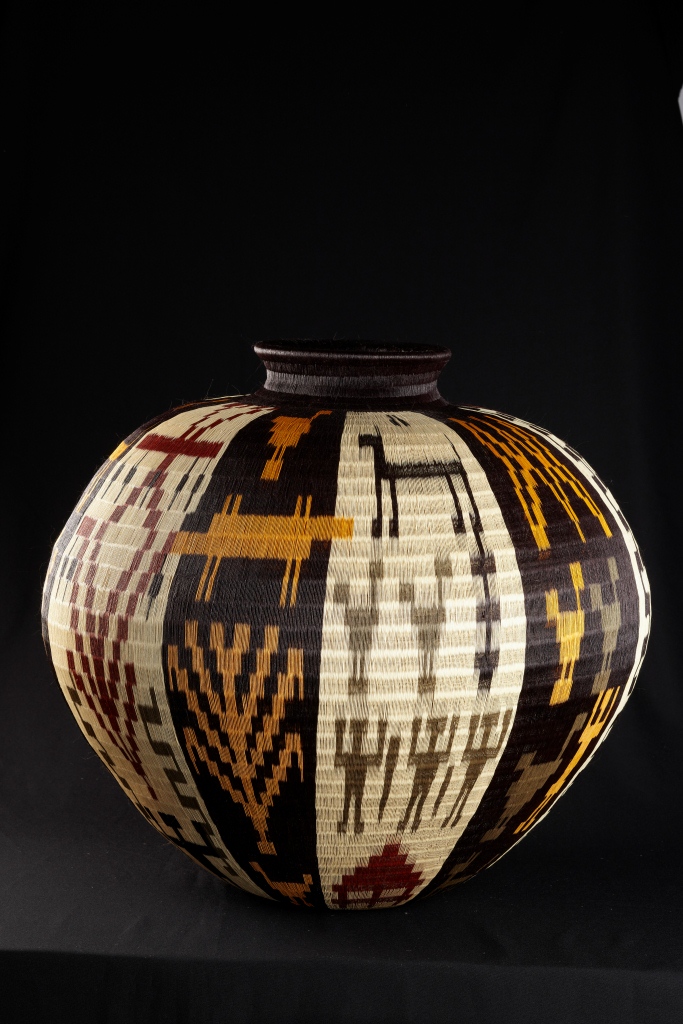
The women process the leaves by cutting them and separating them into strips that they turn into threads for weaving. These are cooked to increase their malleability and add vegetable dyes that give the characteristic black, orange and yellow colors, among others.
Black is obtained through a mud dipping process; the yellow one with bija or annatto seeds and the orange one with saffron.
They are left to dry in the sun and then the construction of the basket begins from the base up. The base is woven in a spiral by winding the flexible threads over a core, generally made of iraca, which serves as a structure to form the basket. The threads are sewn with a needle.
The designs reflect the worldview of the community that they capture in geometric shapes and zoomorphic and anthropomorphic figures.
The craft is taught within the family nucleus and through this, the myths and legends that constitute the wounaan universe are transmitted and that enrich the Colombian cultural heritage materialized in pieces of great quality and beauty that are valued throughout the world and that are currently used as decorative elements in the most sophisticated environments.
Recently, production has diversified, incorporating wood to make various utilitarian items and accessories.
Crucelina Chocho is one of the great teachers, who, in turn, has taught other women in her own community. It has participated in international fairs with great success. Its inspiration comes from its surroundings full of landscapes and the San Juan River where time passes impassively.
Currently, Werregue baskets are made in seven Wounaan reservations and generate income for more than a thousand women who derive their livelihood from this activity.
EnglishWounaan basketry
On the Pacific coast in the south of the department of Choco, on the banks of the Bajo San Juan is located the Wounaan indigenous community, one of the areas of Colombia with the highest rainfall. There they make some of the most beautiful baskets that are produced in the country. The women are dedicated to the craft of basket weaving, using the Werregue palm, which is obtained from the palm of the same name; it grows among mangroves and reaches up to twenty meters in height.
In the past, the men used to cut down the palm, but today, with the help of a half-moon, they obtain the heart and the leaves without cutting it down.
The women process the leaves by cutting them and separating them into strips that they turn into threads for weaving. These are cooked to increase their malleability and to add vegetable dyes that give them the characteristic black, orange and yellow colors, among others.
The black is obtained through a process of immersion in mud; the yellow with annatto seeds and the orange with saffron. They are left to dry in the sun and then the construction of the basket begins from the base upwards. The base is woven in a spiral by winding the flexible threads around a core, usually made of iraca, which serves as a structure to form the basket, and the threads are sewn together with a needle. The designs reflect the worldview of the community, which is expressed in geometric shapes and zoomorphic and anthropomorphic figures.
The craft is taught within the family nucleus and through it, the myths and legends that make up the Wounaan universe are transmitted, enriching the Colombian cultural heritage and materializing in pieces of great quality and beauty that are valued throughout the world and are currently used as decorative elements in the most sophisticated environments. Recently, the production has diversified by incorporating wood to make various utilitarian items and accessories.
Crucelina Chocho is one of the great masters, who in turn has taught other women in her own community. She has participated in international fairs with great success.
Her inspiration comes from her surroundings full of landscapes and the San Juan River where time passes impassively.
Currently, Werregue baskets are made in seven Wounaan reservations and generate income for more than a thousand women who derive their livelihood from this activity.
Valoraciones
No hay valoraciones aún.