Baskets, masks and fiber plates

La elaboración de artesanías de las mujeres de las naciones wounaan y emberá con fibras vegetales requiere de gran conocimiento de la naturaleza. Se realiza con la chunga (Astrocaryum standleyanum) and the naguala (Carludovica palmata). The women clean the bud of the chunga, brought by the men, a tedious task because the chunga is a […]

Descripción

La elaboración de artesanías de las mujeres de las naciones wounaan y emberá con fibras vegetales requiere de gran conocimiento de la naturaleza. Se realiza con la chunga (Astrocaryum standleyanum) and the naguala (Carludovica palmata). The women clean the bud of the chunga, brought by the men, a tedious task because the chunga is a very thorny palm.

The useful strands are deposited in lemon water or in sour water from wild sour reed (Costus spicatus). They boil the fibers to make them stronger.  They leave them for two days of sun and two nights in the serene until their color is completely white. The threads are torn according to the type of piece. The bud of the naguala is processed in the same way and is used to give firmness to the base and upper contours.

For dyes they use leaves, stems, roots, bark, cocobolo wood chips, black mud, among others: blackberry (Chlophora tinctorea), the macano (Diphysa robinoides), wild indigo (Indigofera sp), the red mangrove (Rhizophora mangle), jagua (American genipa), annatto (Bixa Orellana), vein eye (Mucuna sp), vine (Arrabidaea girl), saffron or cori (Curcuma longa). The mixture of each dye is cooked and when boiling they place the fibers. For the black color, they are buried in black mud for hours or cooked with cocobolo chips. The threads are arranged according to the design they have in their minds to harmonize the fabric according to the figures.

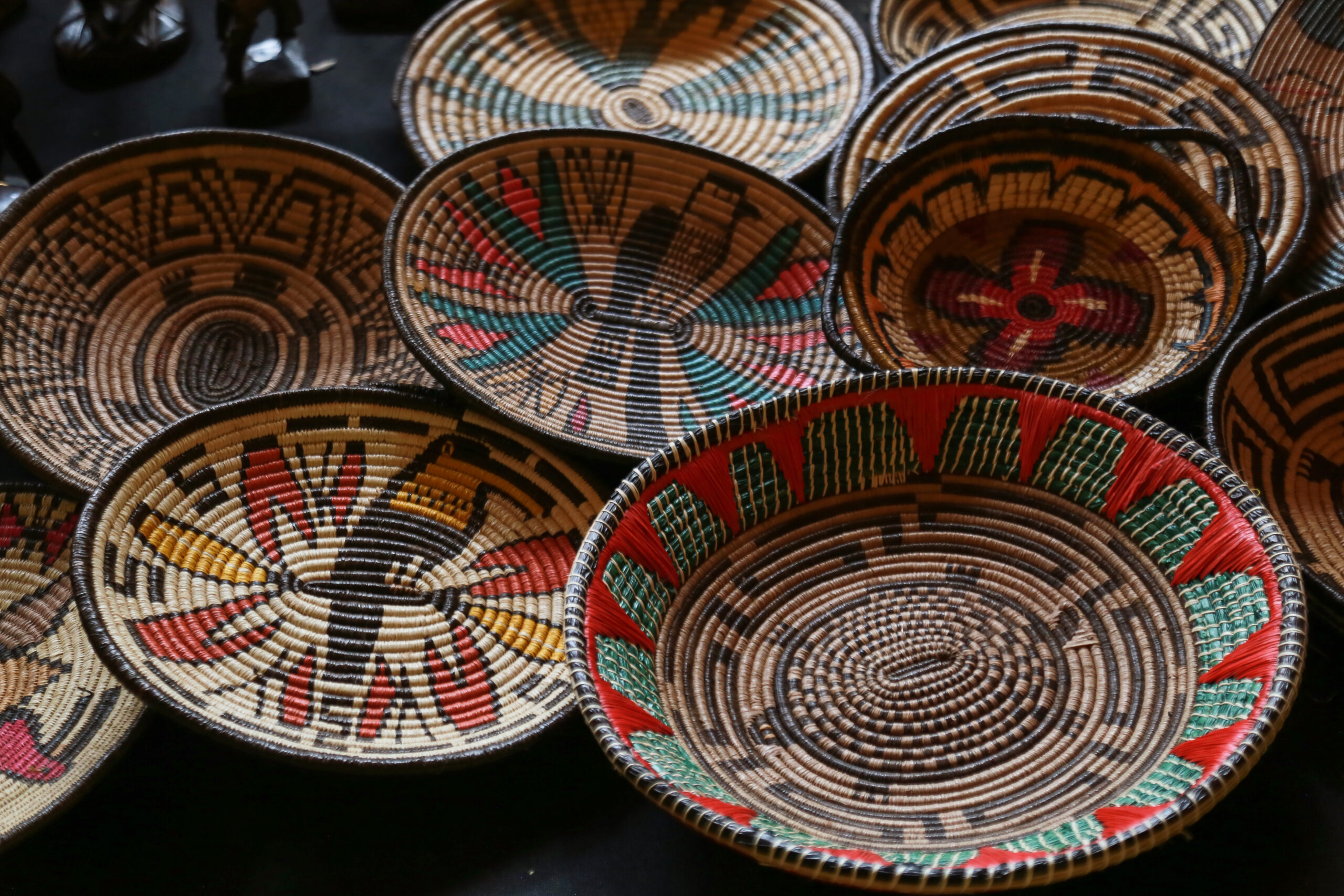
These products can be fine baskets, masks, plates with geometric designs or animals and plants from the environment. Depending on the size, design and type of fabric, a work can be done in a week or a year.

This craft is made in the Emberá Wounaan Region and in the Emberá Wounaan Collective Lands and in the Emberá Collective Lands of Alto Bayano (Panama).

english

Fiber baskets, masks and platesThe production of handicrafts by the women of the Wounaan and Emberá nations with vegetable fibers requires a great knowledge of nature. This is done with the «chunga» (Astrocaryum standleyanum) and the «naguala» (Carludovica palmata). The women clean the buds of the «chunga», brought by the men, a difficult task as the «chunga» is a very thorny palm. The useful strands are placed in water with lemon or in sour water from the wild sour cane (Costus spicatus). They boil the fibers to make them stronger.  They are left for two days in the sun and two nights in the shade until they are completely white in color. The threads are torn according to the type of piece. The heart of the «naguala» is processed in the same way and is used to give firmness to the base and upper contours.

Leaves, stems, roots, bark, wood chips, black mud, etc. are used for dyeing: «mora» (Chlophora tinctorea), «macano» (Diphysa robinoides), wild indigo (Indigofera sp), red mangrove (Rhizophora mangle), «jagua» (Genipa Americana), «achiote» (Bixa Orellana), «ojo de venao» (Mucuna pruriens), «bejuco» (Arrabidaea chica), saffron or «corí» (Curcuma longa). The mixture of each dye is cooked and when it boils, the fibers are placed in it. For the black colour, they are buried in black mud for hours or cooked with cocobolo chips. The yarns are arranged according to the design they have in their minds to harmonize the weaving according to the figures.

These products can be fine baskets, masks, plates with geometric designs or designs of animals and plants from the environment. Depending on the size, design and type of weaving, a piece can be made in a week or a year. This handicraft is made in the «Emberá Wounaan» Comarca and in the «Emberá de Alto Bayano» Collective Lands of Panama.

Valoraciones

No hay valoraciones aún.

Sé el primero en valorar “Baskets, masks and fiber plates”

Tu dirección de correo electrónico no será publicada. Los campos obligatorios están marcados con *

Descripción

La elaboración de artesanías de las mujeres de las naciones wounaan y emberá con fibras vegetales requiere de gran conocimiento de la naturaleza. Se realiza con la chunga (Astrocaryum standleyanum) and the naguala (Carludovica palmata). The women clean the bud of the chunga, brought by the men, a tedious task because the chunga is a very thorny palm.

The useful strands are deposited in lemon water or in sour water from wild sour reed (Costus spicatus). They boil the fibers to make them stronger.  They leave them for two days of sun and two nights in the serene until their color is completely white. The threads are torn according to the type of piece. The bud of the naguala is processed in the same way and is used to give firmness to the base and upper contours.

For dyes they use leaves, stems, roots, bark, cocobolo wood chips, black mud, among others: blackberry (Chlophora tinctorea), the macano (Diphysa robinoides), wild indigo (Indigofera sp), the red mangrove (Rhizophora mangle), jagua (American genipa), annatto (Bixa Orellana), vein eye (Mucuna sp), vine (Arrabidaea girl), saffron or cori (Curcuma longa). The mixture of each dye is cooked and when boiling they place the fibers. For the black color, they are buried in black mud for hours or cooked with cocobolo chips. The threads are arranged according to the design they have in their minds to harmonize the fabric according to the figures.

These products can be fine baskets, masks, plates with geometric designs or animals and plants from the environment. Depending on the size, design and type of fabric, a work can be done in a week or a year.

This craft is made in the Emberá Wounaan Region and in the Emberá Wounaan Collective Lands and in the Emberá Collective Lands of Alto Bayano (Panama).

english

Fiber baskets, masks and platesThe production of handicrafts by the women of the Wounaan and Emberá nations with vegetable fibers requires a great knowledge of nature. This is done with the «chunga» (Astrocaryum standleyanum) and the «naguala» (Carludovica palmata). The women clean the buds of the «chunga», brought by the men, a difficult task as the «chunga» is a very thorny palm. The useful strands are placed in water with lemon or in sour water from the wild sour cane (Costus spicatus). They boil the fibers to make them stronger.  They are left for two days in the sun and two nights in the shade until they are completely white in color. The threads are torn according to the type of piece. The heart of the «naguala» is processed in the same way and is used to give firmness to the base and upper contours.

Leaves, stems, roots, bark, wood chips, black mud, etc. are used for dyeing: «mora» (Chlophora tinctorea), «macano» (Diphysa robinoides), wild indigo (Indigofera sp), red mangrove (Rhizophora mangle), «jagua» (Genipa Americana), «achiote» (Bixa Orellana), «ojo de venao» (Mucuna pruriens), «bejuco» (Arrabidaea chica), saffron or «corí» (Curcuma longa). The mixture of each dye is cooked and when it boils, the fibers are placed in it. For the black colour, they are buried in black mud for hours or cooked with cocobolo chips. The yarns are arranged according to the design they have in their minds to harmonize the weaving according to the figures.

These products can be fine baskets, masks, plates with geometric designs or designs of animals and plants from the environment. Depending on the size, design and type of weaving, a piece can be made in a week or a year. This handicraft is made in the «Emberá Wounaan» Comarca and in the «Emberá de Alto Bayano» Collective Lands of Panama.

Valoraciones

No hay valoraciones aún.

Sé el primero en valorar “Baskets, masks and fiber plates”

Tu dirección de correo electrónico no será publicada. Los campos obligatorios están marcados con *

Descripción

La elaboración de artesanías de las mujeres de las naciones wounaan y emberá con fibras vegetales requiere de gran conocimiento de la naturaleza. Se realiza con la chunga (Astrocaryum standleyanum) and the naguala (Carludovica palmata). The women cleaned the bud of the chunga, brought by the men, a tedious task because the chunga is a very thorny palm.

The useful strands are deposited in lemon water or in sour water from wild sour reed (Costus spicatus). They boil the fibers to make them stronger.  They leave them for two days of sun and two nights in the serene until their color is completely white. The threads are torn according to the type of piece. The bud of the naguala is processed in the same way and is used to give firmness to the base and upper contours.

For dyes they use leaves, stems, roots, bark, cocobolo wood chips, black mud, among others: blackberry (Chlophora tinctorea), the macano (Diphysa robinoides), wild indigo (Indigofera sp), the red mangrove (Rhizophora mangle), jagua (American genipa), annatto (Bixa Orellana), vein eye (Mucuna sp), came (Arrabidaea girl), saffron or cori (Curcuma longa). The mixture of each dye is cooked and when boiling they place the fibers. For the black color, they are buried in black mud for hours or cooked with cocobolo chips. The threads are arranged according to the design they have in their minds to harmonize the fabric according to the figures.

These products can be fine baskets, masks, plates with geometric designs or animals and plants from the environment. Depending on the size, design and type of fabric, a work can be done in a week or a year.

This craft is made in the Emberá Wounaan Region and in the Emberá Wounaan Collective Lands and in the Emberá Collective Lands of Alto Bayano (Panama).

english

Fiber baskets, masks and platesThe production of handicrafts by the women of the Wounaan and Emberá nations with vegetable fibers requires a great knowledge of nature. This is done with the «chunga» (Astrocaryum standleyanum) and the «naguala» (Carludovica palmata). The women clean the buds of the «chunga», brought by the men, a difficult task as the «chunga» is a very thorny palm. The useful strands are placed in water with lemon or in sour water from the wild sour cane (Costus spicatus). They boil the fibers to make them stronger.  They are left for two days in the sun and two nights in the shade until they are completely white in color. The threads are torn according to the type of piece. The heart of the «naguala» is processed in the same way and is used to give firmness to the base and upper contours.

Leaves, stems, roots, bark, wood chips, black mud, etc. are used for dyeing: «mora» (Chlophora tinctorea), «macano» (Diphysa robinoides), wild indigo (Indigofera sp), red mangrove (Rhizophora mangle), «jagua» (Genipa Americana), «achiote» (Bixa Orellana), «ojo de venao» (Mucuna pruriens), «bejuco» (Arrabidaea chica), saffron or «corí» (Curcuma longa). The mixture of each dye is cooked and when it boils, the fibers are placed in it. For the black colour, they are buried in black mud for hours or cooked with cocobolo chips. The yarns are arranged according to the design they have in their minds to harmonize the weaving according to the figures.

These products can be fine baskets, masks, plates with geometric designs or designs of animals and plants from the environment. Depending on the size, design and type of weaving, a piece can be made in a week or a year. This handicraft is made in the «Emberá Wounaan» Comarca and in the «Emberá de Alto Bayano» Collective Lands of Panama.

Valoraciones

No hay valoraciones aún.

Sé el primero en valorar “Baskets, masks and fiber plates”

Tu dirección de correo electrónico no será publicada. Los campos obligatorios están marcados con *

Descripción

The elaboration of handicrafts by the women of the Wounaan and Embera nations with plant fibers requires great knowledge of nature. It is made with chunga (Astrocaryum standleyanum) and naguala (Carludovica palmata). The women clean the bud of the chunga, brought by the men, a tedious task because the chunga is a very thorny palm.

The useful strands are deposited in lemon water or in sour water from wild sour reed (Costus spicatus). They boil the fibers to make them stronger.  They leave them for two days of sun and two nights in the serene until their color is completely white. The threads are torn according to the type of piece. The bud of the naguala is processed in the same way and is used to give firmness to the base and upper contours.

For dyes they use leaves, stems, roots, bark, cocobolo wood chips, black mud, among others: blackberry (Chlophora tinctorea), macano (Diphysa robinoides), wild indigo (Indigofera sp), red mangrove (Rhizophora mangle), jagua (Genipa Americana), annatto (Bixa Orellana), vine eye (Mucuna sp), vine (Arrabidaea girl), saffron or corí (Curcuma longa). The mixture of each dye is cooked and when boiling they place the fibers. For the black color, they are buried in black mud for hours or cooked with cocobolo chips. The threads are arranged according to the design they have in their minds to harmonize the fabric according to the figures.

These products can be fine baskets, masks, plates with geometric designs or animals and plants from the environment. Depending on the size, design and type of fabric, a work can be done in a week or a year.

This craft is made in the Emberá Wounaan Region and in the Emberá Wounaan Collective Lands and in the Emberá Collective Lands of Alto Bayano (Panama).

englishFibre baskets, masks and plates

The production of handicrafts by the women of the Wounaan and Emberá nations with vegetable fibers requires a great knowledge of nature. This is done with the "chunga" (Astrocaryum standleyanum) and the "naguala" (Carludovica palmata). The women clean the buds of the "chunga", brought by the men, a difficult task as the "chunga" is a very thorny palm. The useful strands are placed in water with lemon or in sour water from the wild sour cane (Costus spicatus). They boil the fibers to make them stronger.  They are left for two days in the sun and two nights in the shade until they are completely white in color. The threads are torn according to the type of piece. The heart of the "naguala" is processed in the same way and is used to give firmness to the base and upper contours.

Leaves, stems, roots, bark, wood chips, black mud, etc. are used for dyeing: "mora" (Chlophora tinctorea), "macano" (Diphysa robinoides), wild indigo (Indigofera sp), red mangrove (Rhizophora mangle), "jagua" (Genipa Americana), "achiote" (Bixa Orellana), "ojo de venao" (Mucuna pruriens), "bejuco" (Arrabidaea chica), saffron or "corí" (Curcuma longa). The mixture of each dye is cooked and when it boils, the fibers are placed in it. For the black colour, they are buried in black mud for hours or cooked with cocobolo chips. The yarns are arranged according to the design they have in their minds to harmonize the weaving according to the figures.

These products can be fine baskets, masks, plates with geometric designs or designs of animals and plants from the environment. Depending on the size, design and type of weaving, a piece can be made in a week or a year. This handicraft is made in the "Emberá Wounaan" Comarca and in the "Emberá de Alto Bayano" Collective Lands of Panama.

Valoraciones

No hay valoraciones aún.

Sé el primero en valorar “Baskets, masks and fiber plates”

Tu dirección de correo electrónico no será publicada. Los campos obligatorios están marcados con *

Descripción

La elaboración de artesanías de las mujeres de las naciones wounaan y emberá con fibras vegetales requiere de gran conocimiento de la naturaleza. Se realiza con la chunga (Astrocaryum standleyanum) y la naguala (Carludovica palmata). Las mujeres limpian el cogollo de la chunga, traído por los hombres, tarea tediosa pues la chunga es una palma muy espinosa.

Las hebras útiles se depositan en agua con limón o en agua agria de la caña agria silvestre (Costus spicatus). Hierven las fibras para que sean más resistentes.  Las dejan dos días de sol y dos noches en el sereno hasta que su color sea totalmente blanco. Los hilos son rasgados según el tipo de pieza. El cogollo de la naguala se procesa igual y se emplea para darle firmeza a la base y contornos superiores.

Para los tintes emplean hojas, tallos, raíces, corteza, astillas de madera de cocobolo, fango negro, entre otros: la mora (Chlophora tinctorea), el macano (Diphysa robinoides), el añil silvestre (Indigofera sp), el mangle rojo (Rhizophora mangle), jagua (Genipa americana), achiote (Bixa Orellana), ojo de venao (Mucuna sp), bejuco (Arrabidaea chica), azafrán o corí (Curcuma longa). La mezcla de cada colorante se cocina y al hervir colocan las fibras. Para el color negro se entierran en fango negro por horas o se cocinan con astillas de cocobolo. Los hilos se ordenan según el diseño que tienen en sus mentes para armonizar el tejido según las figuras.

Estos productos pueden ser finas canastas, máscaras, platos con diseños geométricos o de animales y plantas del entorno. Según el tamaño, diseño y tipo de tejido una obra puede hacerse en una semana o en un año.

Esta artesanía se realiza en la Comarca Emberá Wounaan y en las Tierras colectivas Emberá Wounaan y en las Tierras Colectivas Emberá de Alto Bayano (Panamá).

english

Fibre baskets, masks and plates

The production of handicrafts by the women of the Wounaan and Emberá nations with vegetable fibres requires a great knowledge of nature. This is done with the «chunga» (Astrocaryum standleyanum) and the «naguala» (Carludovica palmata). The women clean the buds of the «chunga», brought by the men, a difficult task as the «chunga» is a very thorny palm. The useful strands are placed in water with lemon or in sour water from the wild sour cane (Costus spicatus). They boil the fibres to make them stronger.  They are left for two days in the sun and two nights in the shade until they are completely white in colour. The threads are torn according to the type of piece. The heart of the «naguala» is processed in the same way and is used to give firmness to the base and upper contours.

Leaves, stems, roots, bark, wood chips, black mud, etc. are used for dyeing: «mora» (Chlophora tinctorea), «macano» (Diphysa robinoides), wild indigo (Indigofera sp), red mangrove (Rhizophora mangle), «jagua» (Genipa americana), «achiote» (Bixa Orellana), «ojo de venao» (Mucuna pruriens), «bejuco» (Arrabidaea chica), saffron or «corí» (Curcuma longa). The mixture of each dye is cooked and when it boils, the fibres are placed in it. For the black colour, they are buried in black mud for hours or cooked with cocobolo chips. The yarns are arranged according to the design they have in their minds to harmonise the weaving according to the figures.

These products can be fine baskets, masks, plates with geometric designs or designs of animals and plants from the environment. Depending on the size, design and type of weaving, a piece can be made in a week or a year. This handicraft is made in the «Emberá Wounaan» Comarca and in the «Emberá de Alto Bayano» Collective Lands of Panama.

Valoraciones

No hay valoraciones aún.

Sé el primero en valorar “Canastas, máscaras y platos de fibra”

Tu dirección de correo electrónico no será publicada. Los campos obligatorios están marcados con *