
Description
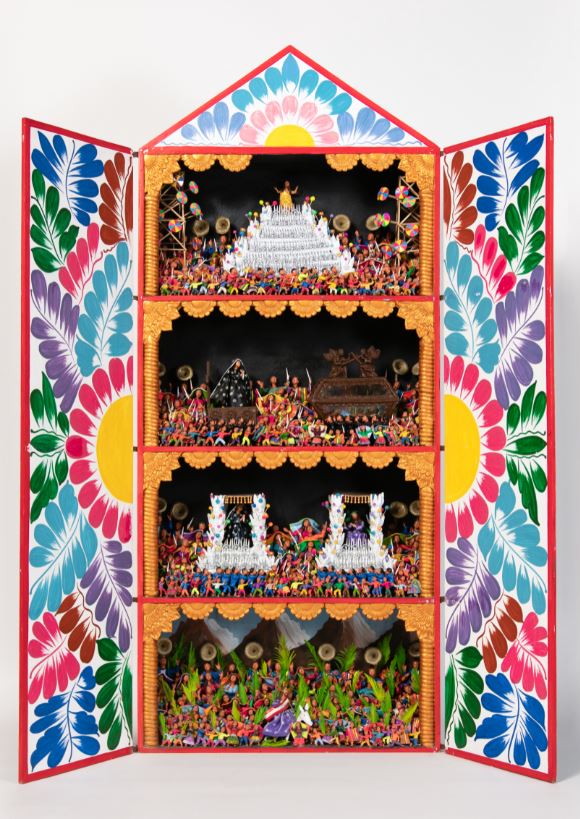
The Ayacucho altarpiece has its origin in the old wooden boxes with figures of saints in paint, bulk or relief created by Christianity in Eastern Europe during the beginning of the Middle Ages, and which in Spain became the "santero chapels" and were introduced in Peru with the establishment of the Viceroyalty.
It was the artisans of the city of Ayacucho who adapted this cultural heritage to their own customs, standing out for their fine work in carving religious figures or modeling in soft materials. The indigenous population made a selection of Catholic saints useful to their faith and placed them in the santero's box, which has a door with two wings decorated on the inside and outside with a design of roses and other flowers that allude to the celestial world and a pediment with equally painted borders. Usually, the interior of the box is made up of two levels, the upper one contains five figures of saints in half relief, on the lower floor scenes of daily life are recreated; It is the representation structured according to the worldview of the hanan pacha (heavenly world above) and the kay pacha (this earthly world).
These objects called “San Marcos or San Lucas drawers” were used by the indigenous population in their magical-religious rites to ask these divinities for the protection and fertility of livestock, in this way and for their communicative function with the spirits of the hill and the land.
In the 1940s, Ayacucho artisans began an artistic transformation in the creation of altarpieces with new themes such as patron saint festivals, traditional dances, cockfights, bullfights, patriotic events, among others, which, little by little, acquired greater prominence. These new forms of manifestation were characterized more by their aesthetic value than by their ritual nature.
The altarpieces have a rectangular shape and are made with cedar wood. While there are no official measurements, the classic designs measure approximately 32cm high and 26cm wide with the doors extended. To make the box, wood of relative size is used, according to the number of scenes and floors that you want to give to the piece. The box is closed at the back and open at the front, has a pediment at the top and doors attached to the sides with leather.
The work begins with whitewashing the box with plaster; once dry, the surface is polychrome and decorated with plant motifs. Inside the box, depending on the levels or floors it presents, the scenes are composed from figurines that usually measure between 6 to 7 centimeters, made of pastes, which are made from plaster sifted with water and flour (some altarpieces use ground potatoes and loquat juice). The mass obtained is modeled by hand or formed in molds to compose the figurines. Once dry, the figurines are polished and painted, and then fixed to the box with glue. The paint used is of the azoic type, known as aniline. The pictorial process involves certain phases: once the figurine is modeled, it is smoothed
Religious manifestations, popular festivals, historical events, and patriotic events such as military parades are represented or they are dedicated to characters, presidents or generals, peasants, heroes, etc.
EnglishAyacucho Altarpiece
The Ayacucho altarpiece has its origin in the ancient wooden boxes with figures of saints in painting, bulk or relief created by Christianity in Eastern Europe during the beginning of the Middle Ages, and which in Spain became the 'santero chapels'. They were introduced in Peru with the establishment of the Viceroyalty and adapted this heritage to their own customs, standing out for their fine work in the carving of religious figures or modeling in soft materials.
The Indigenous population made a selection of Catholic saints useful to their faith and placed them in the santero box, which has a door with two wings decorated on the inside and outside with a design of roses and other flowers that allude to the celestial world, and a pediment with equally painted borders. Usually, the inside of the box is composed of two levels, the upper level contains five figures of saints in half relief, and the lower level recreates scenes of everyday life. It is a structured representation according to the cosmovision of the hanan pacha (heavenly upper world) and the kay pacha (this earthly world). These objects, called 'cajones san marcos or san lucas', were used by the Indigenous population in their magic-religious rites to ask for protection and fertility for their livestock, in this way and because of their communicative function with the spirits of the hills and the earth.
In the 1940s, artisans began a transformation in the elaboration of altarpieces with themes of patron saint festivities, traditional dances, cockfights, bullfights, and patriotic events, among others. These new forms of manifestation were characterized more by their aesthetic value. The altarpieces are rectangular in shape and are made of cedar wood. Although there are unofficial measurements, the classic designs measure approximately 32 cm high and 26 cm wide with the doors extended.
The box is closed at the back and open at the front, with a pediment at the top and doors attached to the sides with leather. The work begins with whitewashing the box with plaster, the surface is polychromed and decorated with vegetal motifs. Inside the box, depending on the levels or floors, the scenes are composed of figurines that usually measure between 6 and 7 centimeters, which are made from plaster sifted with water and flour (some altarpieces use ground potato and loquat juice). The resulting dough is modeled by hand or formed into molds to make the figurines. Once dry, the figurines are polished and painted, and then fixed to the box with glue. The paint used is of the azo type, known as aniline.
The painting process involves certain phases: once the figurines have been modelled, they are smoothed, religious events, popular festivals, historical events, and patriotic events are depicted or dedicated to personalities, presidents, peasants, heroes and other subjects.
Reviews
There are no reviews yet.