
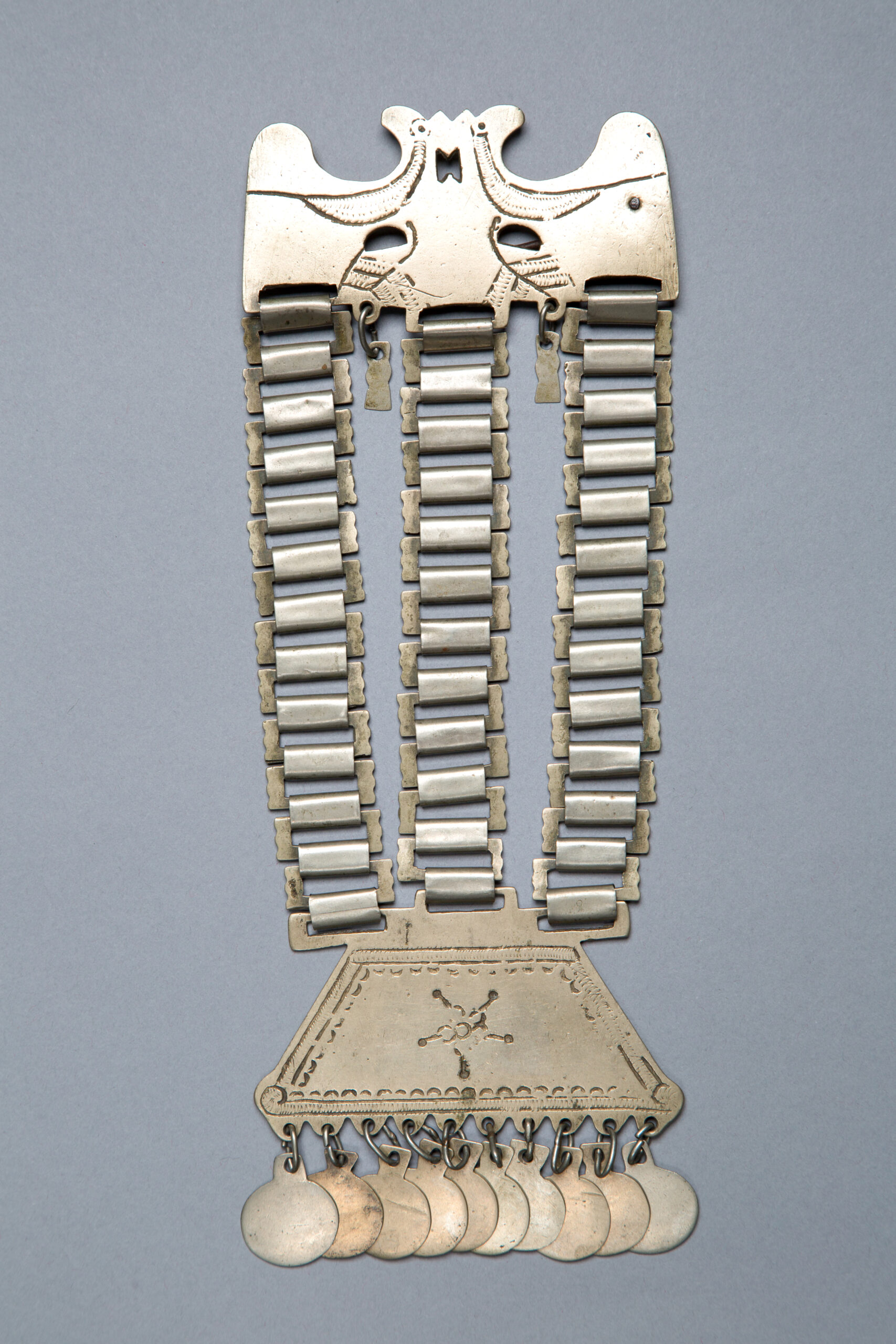
Description
At the time of the Hispanic conquest, the Mapuches lived in the southern territory of Chile, a people that was made up of a series of independent groups that shared the same territory, language and certain cultural traits.
Their traditional economic system was based on hunting and horticulture, then in the 18th and 19th centuries they adapted to a peasant system of agriculture and livestock.
Currently, the Mapuche people present a great cultural fragmentation, with a migration to large cities, mainly in Santiago and Temuco, although linked to different degrees with their communities of origin.
The Mapuche people worked metallurgy in pre-Hispanic times, but it was with the Hispanic encounter that they came to develop a silver metalwork of great richness, symbolism and identity. As material they used the Hispanic silver coins available for trade at the time.
At the end of the 19th century, between 1840 and 1896, Mapuche goldsmithing was at its peak. It had a lot of influence from Creoles who lived with the indigenous people and taught their knowledge.
They made equipment for horses such as spurs, stirrups, and bridles for horses, with which the chiefs demonstrated their wealth and power, as well as a wide range of jewelry for women. These varied over time.
Women's goldsmithing had great growth in those years, when many of the designs were renewed, applying more refined techniques that can be seen in the richness and diversity of pieces that can be found today in collections and museums.
Currently there are many Mapuche silversmiths who continue to make traditional jewelry as well as new versions of them, generalizing a more commercial line, of small format versions of the great pieces of yesteryear. Unfortunately, pieces related to equestrian and everyday objects are no longer produced today.
EnglishMapuche silverware
At the time of the Hispanic conquest, the Mapuche inhabited the southern territory of Chile, a people made up of a series of independent groups that shared the same territory, language and certain cultural traits. Their traditional economic system was based on hunting and horticulture, then in the 18th and 19th centuries they adapted to a peasant system of agriculture and livestock farming.
Currently, the Mapuche people are culturally fragmented, with migration towards the big cities, mainly in Santiago and Temuco, although they are linked to different degrees with their communities of origin.
The Mapuche people worked with metallurgy in pre-Hispanic times, but it was with the arrival of the Spaniards that they developed a rich, symbolic, and highly identifiable silverwork. They used the Hispanic silver coins available for trade at the time. At the end of the 19th century between 1840 and 1896 was the peak of Mapuche goldsmithing. It was greatly influenced by Creoles who lived with the indigenous people and taught them their knowledge. They made horse equipment such as spurs, stirrups and horse bridles, with which the chiefs demonstrated their wealth and power, as well as a wide range of jewelery for the women. These varied over time.
Women's goldsmithing grew considerably during those years, when many of the designs were renewed, applying more refined techniques that can be seen in the richness and diversity of the pieces that can be found today in collections and museums. Nowadays, many of the Mapuche silversmiths still remain in their collections and museums.
Unfortunately, the pieces related to equestrian and everyday objects are no longer produced today.
Reviews
There are no reviews yet.