Description
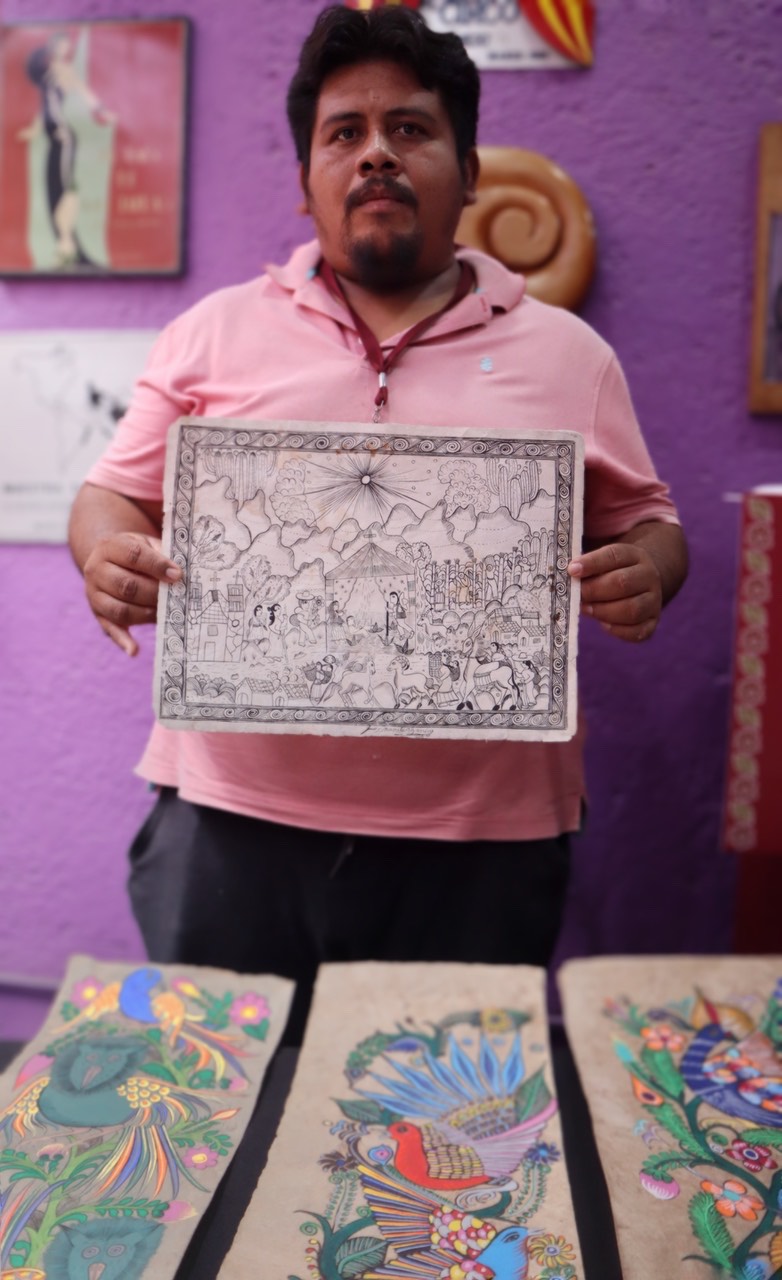
In pre-Hispanic Mexico, various groups left their stories and knowledge captured on strips of paper that they extracted from the leaves of the maguey or the bark of the amate tree.
Today, amate paper, dark brown or straw yellow, continues to be produced in Puebla, State of Mexico. Veracruz, Guerrero and Oaxaca and, just as before, the inhabitants draw stories from the life of their communities on them and make bookmarks and even jewelry with them. In 2022, José Javier Martínez from Tepecoacuilco, Guerrero, won first place in the 2022 National Popular Art Award,
To make it, artisans soak strips of bark that they take from the inside of the tree to soften them, rub them with soap and hit them with stones until they obtain sheets that dry in the sun. Finally they draw on them with natural dyes or acrylic paints.
Crafts are also made with cardboard. The technique arrived in Mexico after the conquest, and was promoted by the friars who used this material to make masks and piñatas to represent stories and offer religious teachings. Today, in some places, in addition to piñatas and masks, toys are made, as is the case in Guanajuato.
The technique is simple. It consists of forming the object using cardboard, paper and paste, smoothing the surface and decorating it. Sometimes, to give it rigidity they use wire, wood or reed.
Some of the most representative pieces of Mexican cardboard are the alebrijes, created in 1936 by Pedro Linares, who during an illness dreamed of fantastic animals that shouted the word alebrijes. When he got better, he made them with cardboard and today hundreds of people are dedicated to it. Maestro Linares obtained the National Prize for Sciences and Arts in 1990.
Extraordinary alebrijes can be seen in the parade that is organized in Mexico City in October of each year.
englishPaper and papier mache
In pre-Hispanic Mexico, various groups recorded their stories and knowledge on strips of paper extracted from the leaves of the maguey or the bark of the amate tree.
Today, amate paper, dark brown or straw yellow in colour, continues to be produced in Puebla, State of Mexico, Veracruz, Guerrero and Guerrero. Veracruz, Guerrero and Oaxaca and, as before, the inhabitants drew stories of the life of their communities on it and made bookmarks and even jewelry out of it. In 2022, José Javier Martínez from Tepecoacuilco, Guerrero, won first place in the National Folk Art Prize 2022. To make it, the artisans soak strips of bark that they remove from inside the tree to soften them, rub them with soap and beat them with a stone until they obtain sheets of bark that they dry in the sun. Finally, they drew on them with natural dyes or acrylic paints.
Cardboard is also used to make handicrafts. The technique arrived in Mexico after the conquest and was promoted by the friars who used the material to make masks and piñatas to represent stories and offer religious teachings. Today, in some places, in addition to piñatas and masks, toys are also made, as is the case in Guanajuato and Mexico City. It consists of forming the object using cardboard, paper and paste, smoothing the surface and decorating it. Sometimes wire, wood or reeds are used to give it rigidity.
One of the most representative pieces of Mexican "paper mache" is the alebrijes, created in 1936 by Pedro Linares, who during an illness dreamed of fantastic animals that shouted the word "alebrijes". When he was relieved, he made them out of cardboard and today hundreds of people are dedicated to it. Maestro Linares was awarded the National Prize for Science and Arts in 1990. Extraordinary "Alebrijes" can be seen in the parade that is organized in Mexico City in October every year.
Reviews
There are no reviews yet.