
Description
Quinchamalí is a town in the Commune of Chillán, within the province of Diguillin, Ñuble Region, Chile. It is historically recognized for the production of black pottery, like its neighboring town, Santa Cruz de Cuca, located to the south of it.
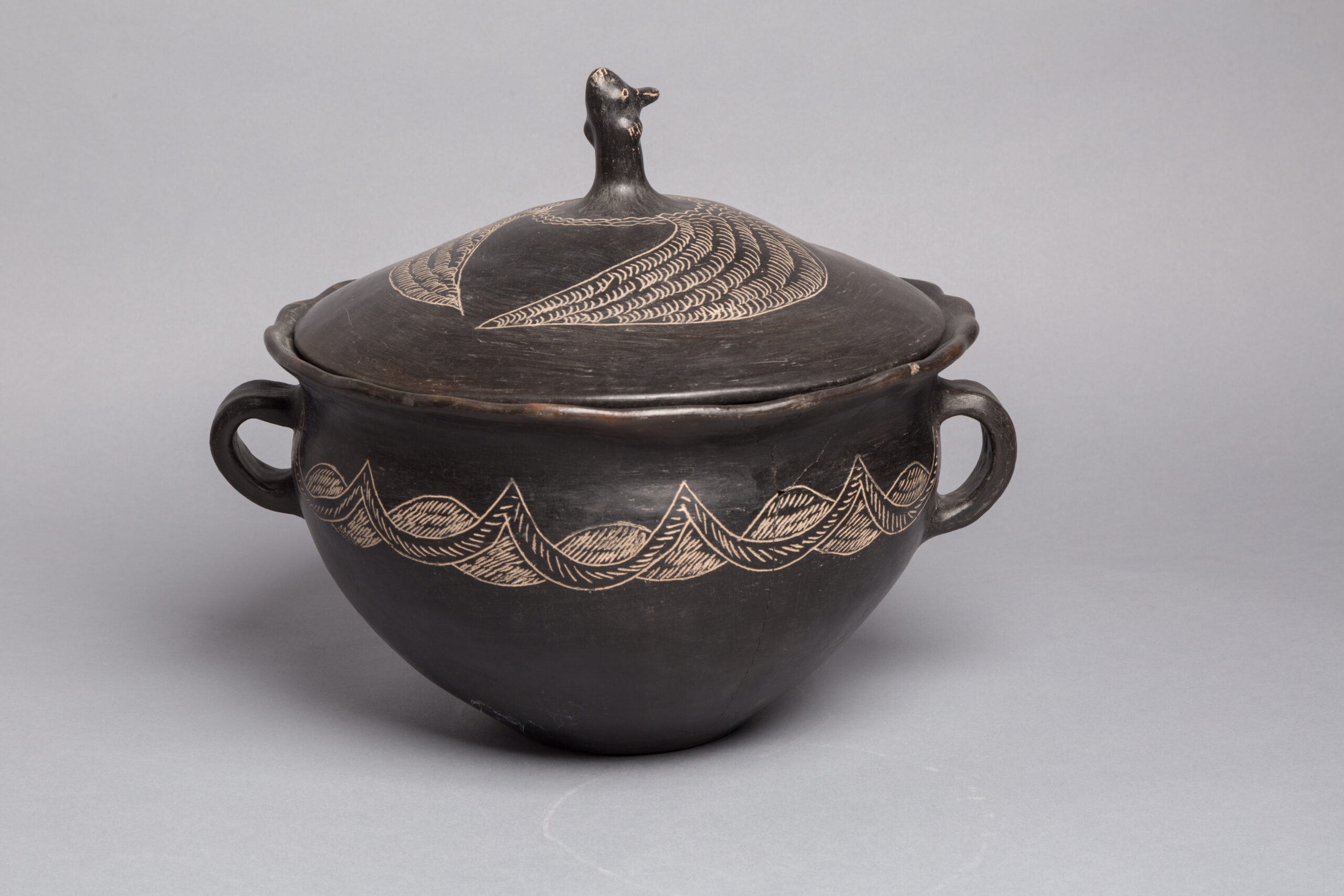
The characteristics of Quinchamalí pottery are its black color, obtained by smoking carried out at the end of the firing process, and its decoration of white incised figures on the burnished surface.
The technique is manual modeling based on globular shapes, that is, a hollowed sphere, made from two half spheres, which together constitute the basis for the design of any figure; They are then differentiated with the elements that are added to this sphere, forming the final object, such as the legs, ears, snout and tail of the figure of a pig.
The function of these pieces is decorative and utilitarian. Among the most recognized are the figures of the guitar player, the goat, the pig, the turkey, among others. Of the utilitarian ones: plates, dishes, cups, jugs, pots and pans
The theme of the incised drawings are forms of phytomorphic and geometric figures. The first show natural elements, such as the ear of wheat and vine guides, and flowers. The geometric motif consists of parallel wavy and serrated lines, which form a texture equal to the lines used as fill within the phytomorphic figures.
The raw materials used for the paste are a lead clay that serves as a base, a little yellow clay from the area is added and finally a degreasing material formed by ground grit.
Currently there is no free access to the site of the earth extraction, since it is on private land, which causes a situation of vulnerability in its continuity.
EnglishPottery of Quinchamali
Quinchamalí is a village in the municipality of Chillán, in the province of Diguillin, Ñuble Region, Chile. It is historically known for the production of black pottery, as is its neighboring town, Santa Cruz de Cuca, located to the south of it. The characteristics of the pottery are its black colour, obtained by smoking at the end of the firing process, and its decoration of white figures incised on the burnished surface. The technique is manual modeling based on globular shapes, i.e. a hollowed out sphere, made from two half spheres, which when glued together form the basis for the design of any figure; they are then differentiated with elements that are added to this sphere, forming the final object, such as the legs, ears, snout and tail of the figure of a pig.
The function of these pieces is decorative and utilitarian. Among the best known are the figures of the woman playing the guitar, the goat, the pig, the turkey, among others. The utilitarian ones include plates, dishes, bowls, jugs, pots and pans. The theme of the incised drawings is phytomorphic and geometric shapes. The former show natural elements, such as the ear of wheat and vine guides, and flowers. The geometric motif consists of parallel wavy and serrated lines, which form a texture similar to the lines used as filler within the phytomorphic figures.
The raw materials used for the paste are lead clay as a base, a little local yellow clay, and finally a degreasing agent made of earthen grit. At present, there is no free access to the place where the earth is extracted, as it is on private land, which makes its continuity vulnerable.
Reviews
There are no reviews yet.