
Paper and cardboard

En el México prehispánico diversos grupos dejaron plasmadas sus historias y sus conocimientos en tiras de papel que extraían de las hojas del maguey o de la corteza del árbol del amate. Hoy, se continúa produciendo papel amate, de color marrón oscuro o amarillo paja, en Puebla, Estado de México. Veracruz, Guerrero y Oaxaca e, […]

Descripción

En el México prehispánico diversos grupos dejaron plasmadas sus historias y sus conocimientos en tiras de papel que extraían de las hojas del maguey o de la corteza del árbol del amate.

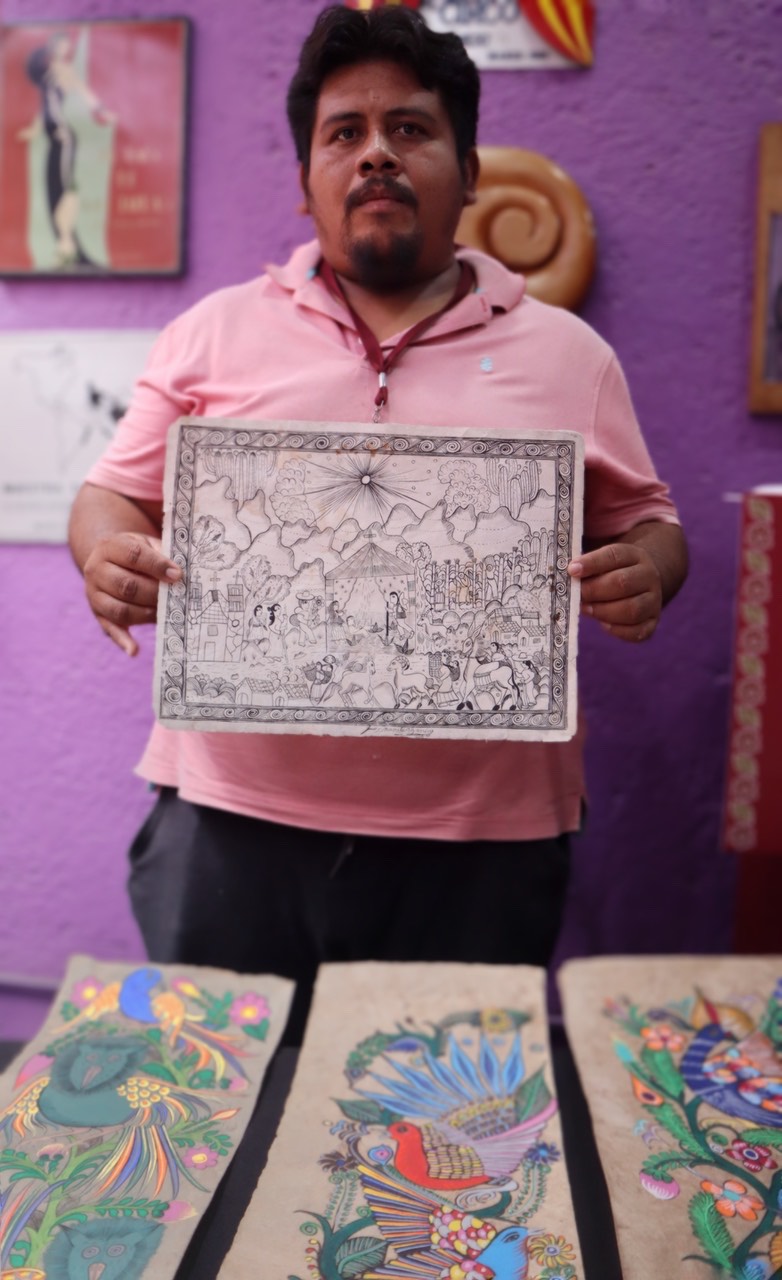
Hoy, se continúa produciendo papel amate, de color marrón oscuro o amarillo paja, en Puebla, Estado de México. Veracruz, Guerrero y Oaxaca e, igual que antes, los habitantes dibujan en ellos historias de la vida de sus comunidades y elaboran con él separadores para libros e incluso joyería. En 2022, José Javier Martínez de Tepecoacuilco, Guerrero, obtuvo el primer lugar del Premio Nacional de Arte Popular 2022,

Para fabricarlo, los artesanos remojan tiras de corteza que sacan del interior del árbol para suavizarlas, las frotan con jabón y las golpean con piedra hasta obtener unas láminas que secan al sol. Finalmente dibujan en ellas con tintes naturales o pinturas acrílicas.

Con cartón también se elaboran artesanías. La técnica llegó a México después de la conquista, y fue impulsado por los frailes quienes con este material hacían máscaras y piñatas para representar historias y ofrecer enseñanzas religiosas. Hoy, en algunos lugares, además de piñatas y máscaras se hacen juguetes, como es el caso de Guanajuato.

La técnica es sencilla. Consiste en formar el objeto usando cartón, papel y engrudo, alisar la superficie y decorarla. En ocasiones, para darle rigidez usan alambre, madera o carrizo.

Unas de las piezas más representativas de la cartonería mexicana son los alebrijes, creados en 1936 por Pedro Linares, quien durante una enfermedad soñó con animales fantásticos que gritaban la palabra alebrijesWhen he got better, he made them with cardboard and today hundreds of people are dedicated to it. Maestro Linares obtained the National Prize for Sciences and Arts in 1990.

Extraordinary alebrijes can be seen in the parade that is organized in Mexico City in October of each year.

english

Paper and papier macheIn pre-Hispanic Mexico, various groups recorded their stories and knowledge on strips of paper extracted from the leaves of the maguey or the bark of the amate tree.

Today, amate paper, dark brown or straw yellow in colour, continues to be produced in Puebla, State of Mexico, Veracruz, Guerrero and Guerrero. Veracruz, Guerrero and Oaxaca and, as before, the inhabitants drew stories of the life of their communities on it and made bookmarks and even jewelry out of it. In 2022, José Javier Martínez from Tepecoacuilco, Guerrero, won first place in the National Folk Art Prize 2022. To make it, the artisans soak strips of bark that they remove from inside the tree to soften them, rub them with soap and beat them with a stone until they obtain sheets of bark that they dry in the sun. Finally, they drew on them with natural dyes or acrylic paints.

Cardboard is also used to make handicrafts. The technique arrived in Mexico after the conquest and was promoted by the friars who used the material to make masks and piñatas to represent stories and offer religious teachings. Today, in some places, in addition to piñatas and masks, toys are also made, as is the case in Guanajuato and Mexico City. It consists of forming the object using cardboard, paper and paste, smoothing the surface and decorating it. Sometimes wire, wood or reeds are used to give it rigidity.

One of the most representative pieces of Mexican «paper mache» is the alebrijes, created in 1936 by Pedro Linares, who during an illness dreamed of fantastic animals that shouted the word «alebrijes». When he was relieved, he made them out of cardboard and today hundreds of people are dedicated to it. Maestro Linares was awarded the National Prize for Science and Arts in 1990. Extraordinary «Alebrijes» can be seen in the parade that is organized in Mexico City in October every year.

Valoraciones

No hay valoraciones aún.

Sé el primero en valorar “Paper and cardboard”

Tu dirección de correo electrónico no será publicada. Los campos obligatorios están marcados con *

Descripción

En el México prehispánico diversos grupos dejaron plasmadas sus historias y sus conocimientos en tiras de papel que extraían de las hojas del maguey o de la corteza del árbol del amate.

Hoy, se continúa produciendo papel amate, de color marrón oscuro o amarillo paja, en Puebla, Estado de México. Veracruz, Guerrero y Oaxaca e, igual que antes, los habitantes dibujan en ellos historias de la vida de sus comunidades y elaboran con él separadores para libros e incluso joyería. En 2022, José Javier Martínez de Tepecoacuilco, Guerrero, obtuvo el primer lugar del Premio Nacional de Arte Popular 2022,

Para fabricarlo, los artesanos remojan tiras de corteza que sacan del interior del árbol para suavizarlas, las frotan con jabón y las golpean con piedra hasta obtener unas láminas que secan al sol. Finalmente dibujan en ellas con tintes naturales o pinturas acrílicas.

Con cartón también se elaboran artesanías. La técnica llegó a México después de la conquista, y fue impulsado por los frailes quienes con este material hacían máscaras y piñatas para representar historias y ofrecer enseñanzas religiosas. Hoy, en algunos lugares, además de piñatas y máscaras se hacen juguetes, como es el caso de Guanajuato.

La técnica es sencilla. Consiste en formar el objeto usando cartón, papel y engrudo, alisar la superficie y decorarla. En ocasiones, para darle rigidez usan alambre, madera o carrizo.

Unas de las piezas más representativas de la cartonería mexicana son los alebrijes, creados en 1936 por Pedro Linares, quien durante una enfermedad soñó con animales fantásticos que gritaban la palabra alebrijesWhen he got better, he made them with cardboard and today hundreds of people are dedicated to it. Maestro Linares obtained the National Prize for Sciences and Arts in 1990.

Extraordinary alebrijes can be seen in the parade that is organized in Mexico City in October of each year.

english

Paper and papier macheIn pre-Hispanic Mexico, various groups recorded their stories and knowledge on strips of paper extracted from the leaves of the maguey or the bark of the amate tree.

Today, amate paper, dark brown or straw yellow in colour, continues to be produced in Puebla, State of Mexico, Veracruz, Guerrero and Guerrero. Veracruz, Guerrero and Oaxaca and, as before, the inhabitants drew stories of the life of their communities on it and made bookmarks and even jewelry out of it. In 2022, José Javier Martínez from Tepecoacuilco, Guerrero, won first place in the National Folk Art Prize 2022. To make it, the artisans soak strips of bark that they remove from inside the tree to soften them, rub them with soap and beat them with a stone until they obtain sheets of bark that they dry in the sun. Finally, they drew on them with natural dyes or acrylic paints.

Cardboard is also used to make handicrafts. The technique arrived in Mexico after the conquest and was promoted by the friars who used the material to make masks and piñatas to represent stories and offer religious teachings. Today, in some places, in addition to piñatas and masks, toys are also made, as is the case in Guanajuato and Mexico City. It consists of forming the object using cardboard, paper and paste, smoothing the surface and decorating it. Sometimes wire, wood or reeds are used to give it rigidity.

One of the most representative pieces of Mexican «paper mache» is the alebrijes, created in 1936 by Pedro Linares, who during an illness dreamed of fantastic animals that shouted the word «alebrijes». When he was relieved, he made them out of cardboard and today hundreds of people are dedicated to it. Maestro Linares was awarded the National Prize for Science and Arts in 1990. Extraordinary «Alebrijes» can be seen in the parade that is organized in Mexico City in October every year.

Valoraciones

No hay valoraciones aún.

Sé el primero en valorar “Paper and cardboard”

Tu dirección de correo electrónico no será publicada. Los campos obligatorios están marcados con *

Descripción

In pre-Hispanic Mexico, various groups left their stories and knowledge captured on strips of paper that they extracted from the leaves of the maguey or the bark of the amate tree.

Today, amate paper, dark brown or straw yellow, continues to be produced in Puebla, State of Mexico. Veracruz, Guerrero and Oaxaca and, just as before, the inhabitants draw stories from the life of their communities on them and make bookmarks and even jewelry with them. In 2022, José Javier Martínez from Tepecoacuilco, Guerrero, won first place in the 2022 National Popular Art Award,

To make it, artisans soak strips of bark that they take from the inside of the tree to soften them, rub them with soap and hit them with stones until they obtain sheets that dry in the sun. Finally they draw on them with natural dyes or acrylic paints.

Crafts are also made with cardboard. The technique arrived in Mexico after the conquest, and was promoted by the friars who used this material to make masks and piñatas to represent stories and offer religious teachings. Today, in some places, in addition to piñatas and masks, toys are made, as is the case in Guanajuato.

The technique is simple. It consists of forming the object using cardboard, paper and paste, smoothing the surface and decorating it. Sometimes, to give it rigidity they use wire, wood or reed.

Some of the most representative pieces of Mexican cardboard are the alebrijes, created in 1936 by Pedro Linares, who during an illness dreamed of fantastic animals that shouted the word alebrijes. When he got better, he made them with cardboard and today hundreds of people are dedicated to it. Maestro Linares obtained the National Prize for Sciences and Arts in 1990.

Extraordinary alebrijes can be seen in the parade that is organized in Mexico City in October of each year.

englishPaper and papier mache

In pre-Hispanic Mexico, various groups recorded their stories and knowledge on strips of paper extracted from the leaves of the maguey or the bark of the amate tree.

Today, amate paper, dark brown or straw yellow in colour, continues to be produced in Puebla, State of Mexico, Veracruz, Guerrero and Guerrero. Veracruz, Guerrero and Oaxaca and, as before, the inhabitants drew stories of the life of their communities on it and made bookmarks and even jewelry out of it. In 2022, José Javier Martínez from Tepecoacuilco, Guerrero, won first place in the National Folk Art Prize 2022. To make it, the artisans soak strips of bark that they remove from inside the tree to soften them, rub them with soap and beat them with a stone until they obtain sheets of bark that they dry in the sun. Finally, they drew on them with natural dyes or acrylic paints.

Cardboard is also used to make handicrafts. The technique arrived in Mexico after the conquest and was promoted by the friars who used the material to make masks and piñatas to represent stories and offer religious teachings. Today, in some places, in addition to piñatas and masks, toys are also made, as is the case in Guanajuato and Mexico City. It consists of forming the object using cardboard, paper and paste, smoothing the surface and decorating it. Sometimes wire, wood or reeds are used to give it rigidity.

One of the most representative pieces of Mexican "paper mache" is the alebrijes, created in 1936 by Pedro Linares, who during an illness dreamed of fantastic animals that shouted the word "alebrijes". When he was relieved, he made them out of cardboard and today hundreds of people are dedicated to it. Maestro Linares was awarded the National Prize for Science and Arts in 1990. Extraordinary "Alebrijes" can be seen in the parade that is organized in Mexico City in October every year.

Valoraciones

No hay valoraciones aún.

Sé el primero en valorar “Paper and cardboard”

Tu dirección de correo electrónico no será publicada. Los campos obligatorios están marcados con *

Descripción

En el México prehispánico diversos grupos dejaron plasmadas sus historias y sus conocimientos en tiras de papel que extraían de las hojas del maguey o de la corteza del árbol del amate.

Hoy, se continúa produciendo papel amate, de color marrón oscuro o amarillo paja, en Puebla, Estado de México. Veracruz, Guerrero y Oaxaca e, igual que antes, los habitantes dibujan en ellos historias de la vida de sus comunidades y elaboran con él separadores para libros e incluso joyería. En 2022, José Javier Martínez de Tepecoacuilco, Guerrero, obtuvo el primer lugar del Premio Nacional de Arte Popular 2022,

Para fabricarlo, los artesanos remojan tiras de corteza que sacan del interior del árbol para suavizarlas, las frotan con jabón y las golpean con piedra hasta obtener unas láminas que secan al sol. Finalmente dibujan en ellas con tintes naturales o pinturas acrílicas.

Con cartón también se elaboran artesanías. La técnica llegó a México después de la conquista, y fue impulsado por los frailes quienes con este material hacían máscaras y piñatas para representar historias y ofrecer enseñanzas religiosas. Hoy, en algunos lugares, además de piñatas y máscaras se hacen juguetes, como es el caso de Guanajuato.

La técnica es sencilla. Consiste en formar el objeto usando cartón, papel y engrudo, alisar la superficie y decorarla. En ocasiones, para darle rigidez usan alambre, madera o carrizo.

Unas de las piezas más representativas de la cartonería mexicana son los alebrijes, creados en 1936 por Pedro Linares, quien durante una enfermedad soñó con animales fantásticos que gritaban la palabra alebrijes. Al aliviarse, los elaboró con cartón y hoy cientos de personas se dedican a ello. El maestro Linares obtuvo el Premio Nacional de Ciencias y Artes en 1990.

Alebrijes extraordinarios pueden verse en el desfile que se organiza en la Ciudad de México en octubre de cada año.

english

Paper and papier mache

In pre-Hispanic Mexico, various groups recorded their stories and knowledge on strips of paper extracted from the leaves of the maguey or the bark of the amate tree.

Today, amate paper, dark brown or straw yellow in colour, continues to be produced in Puebla, Estado de México, Veracruz, Guerrero and Guerrero. Veracruz, Guerrero and Oaxaca and, as before, the inhabitants draw stories of the life of their communities on it and make bookmarks and even jewellery out of it. In 2022, José Javier Martínez from Tepecoacuilco, Guerrero, won first place in the National Folk Art Prize 2022. To make it, the artisans soak strips of bark that they remove from inside the tree to soften them, rub them with soap and beat them with a stone until they obtain sheets of bark that they dry in the sun. Finally, they draw on them with natural dyes or acrylic paints.

Cardboard is also used to make handicrafts. The technique arrived in Mexico after the conquest and was promoted by the friars who used the material to make masks and piñatas to represent stories and offer religious teachings. Today, in some places, in addition to piñatas and masks, toys are also made, as is the case in Guanajuato and Mexico City. It consists of forming the object using cardboard, paper and paste, smoothing the surface and decorating it. Sometimes wire, wood or reeds are used to give it rigidity.

One of the most representative pieces of Mexican «paper mache» is the alebrijes, created in 1936 by Pedro Linares, who during an illness dreamt of fantastic animals that shouted the word «alebrijes». When he was relieved, he made them out of cardboard and today hundreds of people are dedicated to it. Maestro Linares was awarded the National Prize for Science and Arts in 1990.  Extraordinary «Alebrijes» can be seen in the parade that is organised in Mexico City in October every year.

Valoraciones

No hay valoraciones aún.

Sé el primero en valorar “Papel y cartonería”

Tu dirección de correo electrónico no será publicada. Los campos obligatorios están marcados con *