
Descripción
La artesanía de mayor arraigo en Venezuela es el tejido de hamacas a cargo principalmente de mujeres que a su vez son jefas del hogar.
Los hombres se dedican al oficio de la cestería y colaboran con las mujeres en el proceso de extracción de las fibras para hacer las hamacas, en especial las de curagua en la población de Aguasay, Estado Monagas
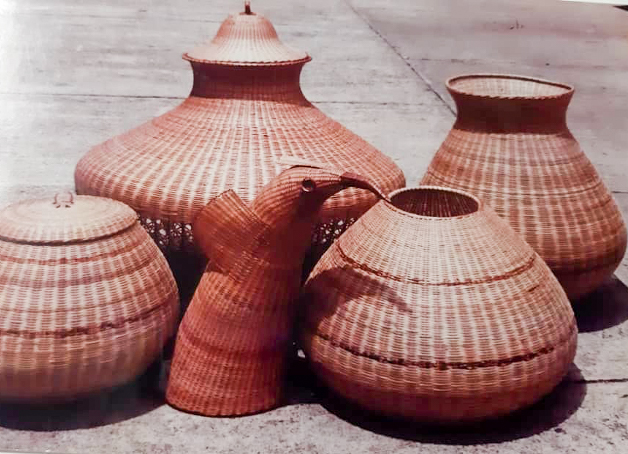
Raw materialsAmong the large number of fibers suitable for weaving hammocks are moriche and cumare palms. Other fibers from small plants are those of the maguey (agave Americana) and the curagua, which is in the process of extinction. Nowadays, the use of cotton in bright colors is more popular for hammocks woven on a pedal loom, where bedspreads, table runners, placemats and small rugs are also woven.The basket weavingTirite (bamboo), bordoncillo, various reeds, mule tail, cattail, date palm, banana stem, vetiver, chiquichiqui, lianas and vine peeled from guaragua, reeds and caraña palm are some names from an immense list of fibers that have made possible the development of vigorous basketry throughout the national territory.
Techniques: The hammocks are woven on a vertical loom of pre-Hispanic origin, which consists of two forks and two crossed poles. The pedal looms introduced by the Spanish are used in the Andean region and in the Lara State.
Two basic techniques are practiced in basket weaving:
- Cross-over
- Torsion.
The crossing presents variants. If the elements pass once above and once below the warp, it is like weaving on a loom. When the elements pass over and under the structure that serves as the basis of the fabric, it is called twill.
In twisting, the elements are chained around a spiral of hard but flexible fiber with single or double knots. There are numerous variants depending on the raw materials used in the warp and weft.
english
Hammock and basket weavingThe most deeply rooted handicraft in Venezuela is hammock weaving, which is mainly carried out by women who are also heads of households. The men are dedicated to the craft of basket weaving and collaborate with the women in the process of extracting the fibers to make them, especially those of «curagua» (fiber) in the town of Aguasay, Monagas State.
Among the large number of fibers suitable for hammock weaving are the «moriche» and «cumare» palms. Other small plant fibers are those of the «maguey» (agave Americana) and the «curagua», which is in the process of extinction. Nowadays, the use of brightly colored cotton for hammocks woven on a treadle loom is more popular, where bedspreads, table runners, placemats and small rugs are also woven.
Tirite basketry (bamboo), «bordoncillo», various reeds, «cola de mula», «enea», date palm, banana stem, «vetiver», «chiquichiqui», lianas, reeds and caraña palm are some of the names of an immense list of fibers that have made possible the development of a vigorous basketry throughout the national territory. Hammocks are woven on a vertical loom of pre-Hispanic origin, which consists of two forks and two crossed sticks. The pedal looms introduced by the Spanish are used in the Andean region and in Lara State.
Two basic techniques are used in basket weaving: Twisting and twisting. There are several variants of interweaving. If the elements pass once above and once below the warp, it is like weaving on a loom. When the elements pass above and below the structure on which the fabric is based, it is called twill weave. In twisting, the elements are strung around a spiral of stiff but flexible fiber with single or double knotting. There are numerous variants depending on the raw materials used in the warp and weft.
Valoraciones
No hay valoraciones aún.