
Descripción
El sombrero pintao se confecciona de manera tradicional, con materiales obtenidos de cinco plantas, en la provincia de Coclé, Panamá.
Los cogollos tiernos de bellota (Carludovica palmata) are torn, washed, cooked and dried in the open air, and then weaved into braids or crinejas. The thickness of the tear and the number of fibers determine the turns that the hat will have and whether it will be for work or for special occasions.
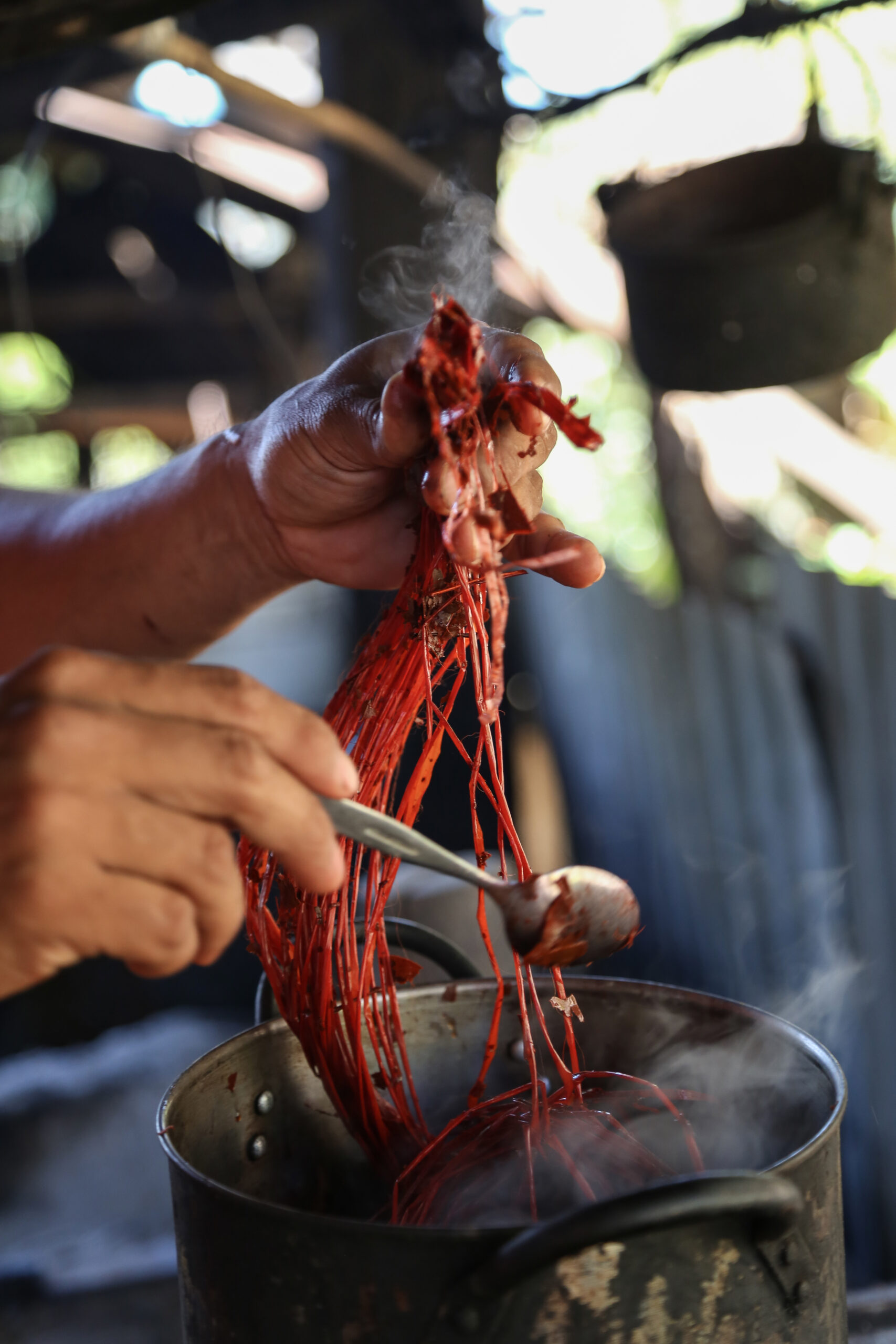
The fibers of the reed (Cyperus holoschoenus, from the Capyraceas) are obtained with several processes of cutting, beating, drying, “drowning” and new drying. The leaves of the chonta palm (Astrocaryum standleyanum) are more difficult to obtain and tear as it is a thorny palm. Both are torn and cooked with chisná leaves (Arrabidaea girl) to dye them a reddish color. Then they are immersed for a day in swamp mud, so that they acquire the black color. To make the black color more intense, they are boiled again with chisná leaves.
The white fibers of the acorn are woven into crinejas. Most of the pintao hat is made of natural-colored crinejas. The fibers of the reed and chonta, already dyed black, are used for cross-weaving with the fibers of the white acorn to obtain the talcum powder and the black spots on the hat.
To shape the hat and sew the crinejas, powders and pints, a fine thread obtained from the pita (Furcraea cabuya). They are joined in a circular shape around a wooden last, which gives shape to the crown of the hat (in different sizes).
This craft is used at work, in celebrations and as part of traditional clothing. Their techniques were inscribed on the UNESCO Intangible Cultural Heritage List in 2017.
english
Pintao HatThe «pintao» hat is made in the traditional way, with materials obtained from five plants, in the province of Coclé in Panama. The tender buds of the acorn (Carludovica palmata) are torn, washed, cooked and dried in the open air, and then woven into braids or «crinejas». The thickness of the tearing and the number of fibers determine the number of turns the hat will have and whether it will be a working hat or a hat for special occasions.
The fibers of the reed (Cyperus holoschoenus, of the Capyraceae) are obtained by various processes of cutting, beating, drying, «drowning» and re-drying. The leaves of the «chonta» palm (Astrocaryum standleyanum) are more difficult to obtain and tear as it is a thorny palm. Both are torn and cooked with «chisná» (Arrabidaea chica) leaves to dye them a reddish colour. They are then immersed for a day in bog mud to give them the black colour.
The white fibers of the acorn are woven into «crinejas». Most of the «pintao» hat is made of natural-colored «crinejas». The fibers of the «junco» and the «chonta», already dyed black, are used for cross weaving with the fibers of the white acorn to obtain the talc and the black pints of the hat.
A fine thread obtained from the «pita» (Furcraea cabuya) is used to shape the hat and to sew the «crinejas», «talcos» and «pintas». They are joined in a circular shape around a wooden frame, which gives shape to the hat’s crown (in different sizes).
This craft is used at work, at celebrations and as part of traditional clothing. Its techniques were inscribed on the UNESCO Intangible Cultural Heritage List in 2017.
Valoraciones
No hay valoraciones aún.