Descripción
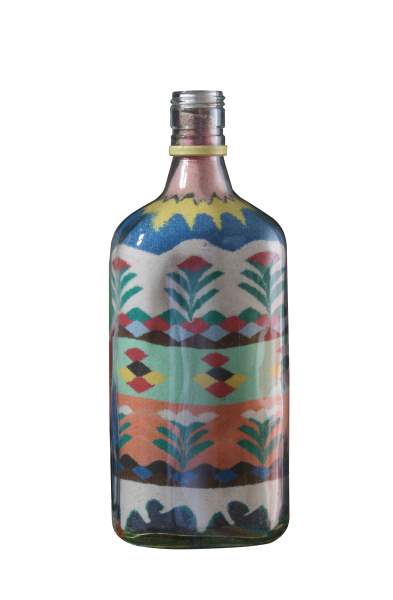
Filling sand bottles (تعبئة زجاجات الرمل الملون, Tabe’at Zojajat Al Ramel Al Molawan) is a distinguished and unique handicraft of Jordan. It originated in Petra and Wadi Rum.
Petra, the capital of Nabataea’s kingdom and one of the seven wonders of the modern world, is also referred to as the Rose City (due to the pink colouration of the stone). It is a historical city in the southern Jordanian governorate of Ma’an. Petra is famous for its rock-cut architecture style.
The art of sand bottles was inspired by Petra’s multicoloured sandy rocks in the 1920s. These glass bottles were filled with layers of sand to reflect the beauty and colours of Petra’s landscape. The first man to work as a desert coloured sand bottle artist in Jordan was Khalifa Krishan. Born in 1885, Khalifa Krishan worked as a painter for the border control force between the Aqaba and Al Qoura area. He started to collect empty bottles delivered by British soldiers and began to create simple designs using multicoloured layers of sands.
The raw materials needed to make sand bottles are recycled blown glass bottles and sand. The initial process involves dyeing the white sand in order to create colours needed for their unique designs. However, some of the artists still use the natural coloured sand to make their products.
The art of filling the coloured sand bottles is made by both men and women. It requires speed because it is a live art that is demonstrated in front of an audience. In this art show, tourists can ask the artist to draw something special for them, like writing their names or make private symbols. This art also requires concentration and a steady hard to control the flow of the sand. Each artist has control over the planning and execution of the designs.
Designs reflect the originality of the Jordanian environment including relics, birds, mountains, seas, sun and sand. The patterns depict the life of the people in Jordan, particularly in rural areas and in the desert.

Tareq Hamdu hands showing the technique of Desert coloured Sand bottles
Photograph: Adeeb Atwan
Sand bottles are widely used to decorate the halls of hotel, lobbies of Jordan and are also popular gifts for birthdays. In addition to this, sand bottles have become a favorite souvenir to tourists because of their beauty and low cost.
The estimated number of sand bottle artists in Jordan is over 110. Sand bottle products are available in specialty craft stores found especially in Petra, Aqaba, Jerash, Madaba and Amman.
Mr. Tareq Hamdu, from Amman, is a master in this art. He started to learn and work as a coloured sand bottles artist at the age of thirteen with his brother. His work started to gain recognition ten years ago, when he invented new tools that helped him to be more accurate and create new and difficult designs.
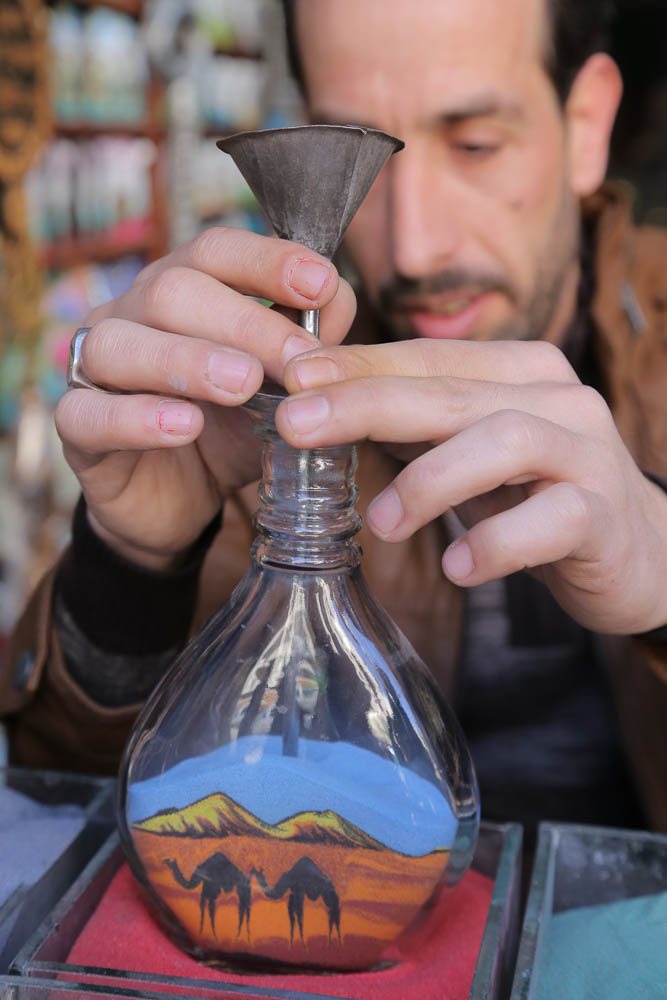
Mr. Tareq Hamdu practicing art of coloured sand bottles at his workshop, Amman
Photograph: Adeeb Atwan
Valoraciones
No hay valoraciones aún.