
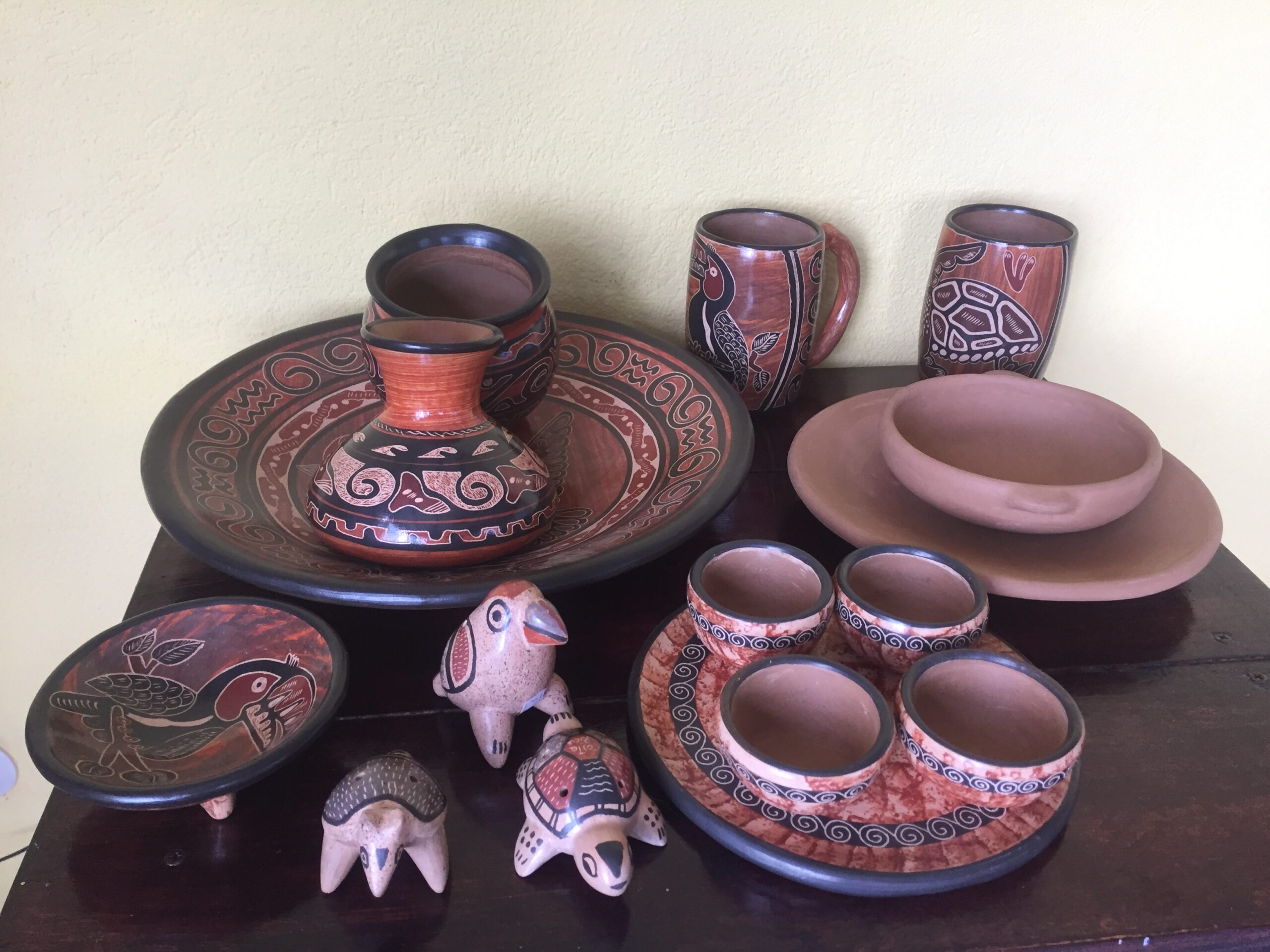
Descripción
Cerámica Chorotega de las comunidades de Guaitil y San Vicente de los Cantones de Santa Cruz y Nicoya en la provincia de Guanacaste.
En esta zona, llamada la Gran Nicoya, la actividad alfarera se mantuvo durante miles de años; en investigaciones realizadas, se ha estimado que esta tradición tiene unos 4000 años de antigüedad, logrado perdurar y transmitirse de generación en generación. Guaitil y San Vicente, mantienen un gran arraigo en la producción alfarera artesanal de piezas utilitarias para la cocción y almacenaje de alimentos principalmente y donde la decoración de las piezas cerámicas fue parte de una evolución en la elaboración, la cual llegó posteriormente a alcanzar altos grados de complejidad y belleza en sus trazos.
Gracias a la alta demanda de cerámica utilitaria a finales de la década de los años 40 y 50 (debido a la escasez de utensilios de aluminio y metal, ligado a la Segunda Guerra Mundial), los pueblos de Guaitil y San Vicente se dieron a conocer a nivel nacional por sus tinajas y cacerolas. Posteriormente, para la década de los 90’s, con el boom turístico en la región, la fabricación de cerámica se configuró en la principal actividad económica de estas comunidades, realizada tanto por hombres como por mujeres.
Con el paso del tiempo, las técnicas de elaboración han tenido algunas modificaciones con respecto a la práctica original indígena, pero ésta, conserva esencialmente sus ingredientes principales: la arcilla y la denominada “arena iguana”, que le da forma a la vasija y el “curiol” pintura natural que le da vida y matices a las piezas, en rojo, blanco y negro (Pizarro y Marchena, 2009: 2).
Para ir levantando y dándole forma a la arcilla, se pueden usar varias técnicas; la más utilizada es el enrollado de tiras o rollos que se van incorporando a una base de arcilla, la base o molde se puede montar sobre una tabla circular puesta sobre el roll o torneta que gira, o un molde cerámico, ambas con la forma que tendrá el fondo de la vasija.
La cerámica chorotega es única en el mundo, cuenta con su respectiva denominación de origen desde 2019. Se identifican tres líneas o estilos de productos: Estilo tradicional, estilo chorotega renovado y estilo ecológico.
The traditional styleIt is characterized by utilitarian products that remained until the mid-20th century, associated with the domestic tasks of maintaining water, cooking and serving food, and some figures of pre-Columbian origin such as the mucuras; as well as the comales and the water jars. In itrenewed chorotega styleCreative innovations from pieces of pre-Columbian origin are incorporated. It presents exact replicas of indigenous pieces obtained from pre-Columbian contexts by looting burials or by references in archeology books with pieces that mix shapes and stylistic finishes in original combinations. He andecological styleIt is innovative by incorporating ecological motifs, which emerged in the 1960s, when the pottery industry began to convert to the tourist market, promoting a transition more towards a style of literal drawings of nature, with fauna motifs such as turtles, hummingbirds and butterflies and plant motifs such as flowers and leaves.
The COOPESANGUAI, a cooperative that brings together artisans who produce Chorotega ceramics from these two communities, has 84 members. However, some of them are not active and others have had to change activities to support their families, especially since the COVID 19 pandemic, as ceramic sales and production fell.
Those interested will be able to obtain Chorotega ceramic crafts and see and experience the entire production process in the communities of Guaitil and San Vicente. In the workshops of the pottery artisans
and in its small shops; There is also an ecomuseum, where the entire history and production process in this regard is represented and it has a store. In the main craft stores located in the main tourist centers of the country.
Most of the 84 artisan members of COOPESANGUAI can be considered masters of this craft; However, some of the best known are: Nury Marchena, Maribel Sánchez, Elpidio Chavarría, Ilsa Chavarría, Porfirio Grijalba, Miguel Leal Vega, Derix Briceño Espinoza, Ermelinda Cascante Marchena, Harry García Grijalba, Jesús Villarreal Leiton, María Padilla Vega, Imelda Campos Chavarría, Junior Matarrita Leal. All of them have the COSTA RICA ARTISANAL Seal.
english
Chorotega CeramicsChorotega pottery can be found in the communities of «Guaitil», «San Vicente de los Cantones de Santa Cruz» and «Nicoya in the province of Guanacaste». In this area, called the «Great Nicoya», pottery activity has been maintained for hundreds of years. Research has estimated that this tradition is about 4,000 years old, and has managed to endure and be passed on from generation to generation. They are deeply rooted in the production of handmade pottery for cooking and storing food, where the decoration of the ceramic pieces was part of an evolution that later reached high levels of complexity and beauty in its lines.
Thanks to the high demand for utilitarian ceramics in the late 1940s and 1950s (due to the shortage of aluminum and metal utensils linked to World War II), these towns became nationally known for their jars and pots. Later, by the 1990s, with the tourist boom in the region, pottery-making became the main economic activity in these communities, carried out by both men and women.
With the passage of time, the production techniques have undergone some modifications and essentially preserve their main characteristics: clay and the so-called «iguana sand», which gives shape to the vessel, and the «curiol» natural paint that gives life and nuances to the pieces, in red, white and black (Pizarro and Marchena, 2009: 2). Various techniques can be used to lift and shape the clay; the most commonly used is the rolling of strips or coils that are incorporated into a clay base; The base can be mounted on a circular table that rotates, both with the shape that will form the bottom of the vessel.
Chorotega pottery is unique in the world and has had its own designation of origin since 2019. Three product lines or styles are identified: traditional, renewed Chorotega style and ecological style. The traditional style is characterized by utilitarian products that remained until the middle of the 20th century, associated with the domestic tasks of keeping water, cooking and serving food, and some figures of pre-Columbian origin such as the «múcuras», as well as comales and water jars. The renovated Chorotega style incorporates creative innovations of pre-Columbian origin. It presents exact replicas of indigenous pieces obtained from pre-Columbian contexts by looting burials or by references in archaeological books with pieces that mix shapes and stylistic finishes in original combinations. The ecological style is innovative, incorporating ecological motifs, which emerged from the 1960s, when the pottery industry began to convert to the tourist market, encouraging a transition more towards a style of literal drawings of nature, with fauna motifs such as turtles, hummingbirds and butterflies, and plant motifs such as flowers and leaves.
COOPESANGUAI, a cooperative that brings together artisans, has 84 members. However, some of them are no longer active and others have had to change their activities to support their families, especially since the COVID 19 pandemic, when pottery sales and production fell. They can be found in the main craft shops located in the main tourist centers of the country.
Valoraciones
No hay valoraciones aún.