
Descripción
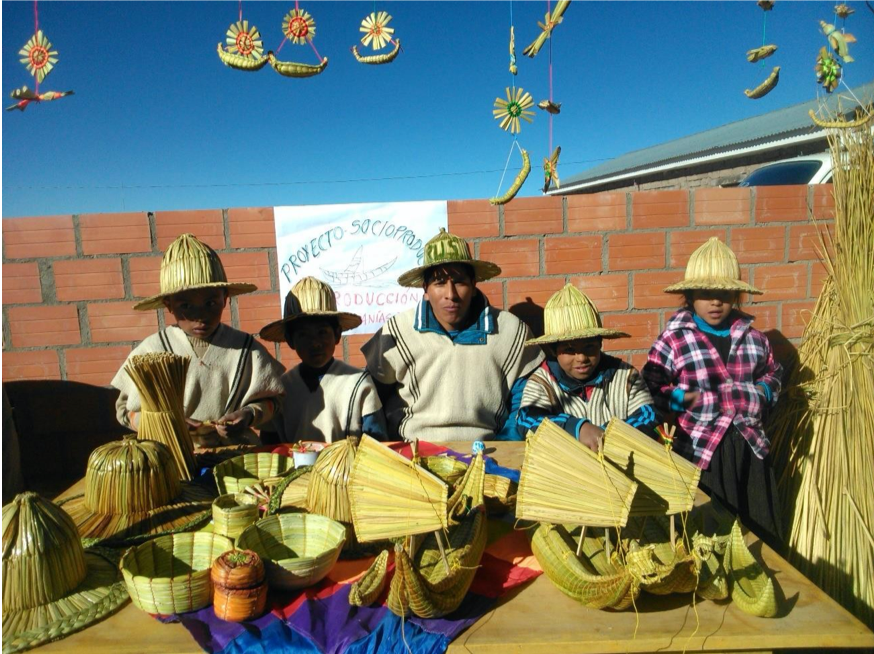
Artesanías Urus en Totora
Los Urus son los habitantes más antiguos del Altiplano Andino. Se autoidentifican como qhas qot zoñi (gente del agua), cuyo medio principal de vida, desde tiempos remotos, ha sido la pesca, caza y recolección en ambientes lacustres. La cultura Uru está estrechamente vinculada a las aguas y sus recursos, uno de ellos es la totora, que es una planta acuática como una especie de junco, entre 1.5 y 3m de altura, que crece a escasa profundidad.
En el pasado, la totora era un recurso fundamental en la vida de los Urus. Les servía de alimento, medicina, construcción de balsas, viviendas, esteras y otros objetos de uso doméstico. Durante la época colonial, frente a la ocupación paulatina de su territorio por otros pueblos: aymaras, quechuas y españoles, los Urus buscaron refugio en las aguas, viviendo en islas artificiales de totora o en grandes balsas que albergaban familias de hasta 15 miembros.
Balsas de Totora
Como navegantes primigenios de los lagos altiplánicos, los Urus construyeron balsas de totora, cuyo conocimiento se mantiene hasta hoy. El proceso de preparación comienza con el segado de la totora, luego se hace secar para que adquiera consistencia, se continúa con la selección de los mejores ejemplares. Para la construcción de balsas se remoja la totora para su fácil manipulación, se colocan amarros de totora sobre delgadas y resistentes cuerdas, unos sobre otros, hasta formar un bloque o cilindro.
El cuerpo de la balsa tiene dos bloques laterales y un bloque central más delgado llamado chuymaor heart. These blocks are joined firmly with a rope, to shape the raft little by little. To do this, you have to tighten the ropes repeatedly from one side to the other, pushing with your feet so that the blocks are very compact. In the process, the ends must be raised so that the raft assumes its final shape. Finally, two thin cylinders of reed are prepared and placed on the edges of the raft. In some cases, a reed mat is also placed to serve as a sail.
Currently, the Urus and other artisans who live on the shores of the lakes continue with the practice of building reed rafts, but no longer for everyday use, but for tourists to take. They also make small rafts, which along with other reed objects: basketry, hats, ornaments, etc., are offered as souvenirs in the riverside communities of Lake Titicaca and Lake Poopó.
It is worth highlighting the transpacific expeditions in large reed boats carried out by different researchers: the Norwegian Thor Heyerdahl in 1947, the Spanish José Kitín Muñoz in 1999 and the American Phil Buck in the years 2000, 2003 and 2016; with the purpose of proving that in the past these ships were used to cross the Pacific, from South America to Polynesia.
english
Urus handicrafts in totoraThe Urus are the oldest inhabitants of the Andean Altiplano. They self-identify asqhas qot zoñi(people of the water), whose main livelihood, since ancient times, has been fishing, hunting and gathering in lake environments. The Uru culture is closely linked to the water and its resources, one of which is the «totora» (Typha, Linnaeus), which is an aquatic plant like a kind of reed, between 1.5 and 3m high, which grows at shallow depths.
In the past, the «totora» was a fundamental resource for them. It was used for food, medicine, construction of rafts, houses, mats and other domestic objects. During the colonial period, faced with the gradual occupation of their territory by other peoples—Aymara, Quechua and Spanish—they sought refuge in the waters, living on artificial islands of «totora» reeds or in large rafts that housed families of up to 15 members.
Totora rafts
As primordial navigators of the Altiplano lakes, the Urus built rafts, the knowledge of which is maintained to this day. The process of preparation begins with the mowing, then it is dried so that it acquires consistency, and continues with the selection of the best specimens. For the construction of rafts, the wood is soaked for easy handling, and then the moorings are placed on thin, resistant ropes, one on top of the other, until they form a block or cylinder.
The body of the raft has two lateral blocks and a thinner central block calledchuymaor heart. These blocks are firmly joined together with a rope to shape the raft little by little. To do this, the ropes must be tightened repeatedly from one side to the other, pushing with the feet so that the blocks are very compact. In the process, the ends must be lifted so that the raft assumes its final shape. Finally, two thin cylinders ofcattailare prepared and placed at the edges of the raft. In some cases, a mat is also placed to serve as a sail.
Nowadays, the Urus and other artisans who live on the shores of the lakes continue with the practice of building rafts, but no longer for everyday use, but for tourists. They also make small rafts, which together with other objects made of reeds. Basketry, hats, ornaments, etc., are offered as souvenirs in the riverside communities of Lake Titicaca and Lake Poopó.
It is worth mentioning the transpacific expeditions in large totora boats carried out by different researchers: the Norwegian Thor Heyerdahl in 1947, the Spaniard José Kitín Muñoz in 1999 and the American Phil Buck in 2000, 2003 and 2016; with the aim of proving that in the past these boats were used to cross the Pacific, from South America to Polynesia.
Valoraciones
No hay valoraciones aún.