
Descripción
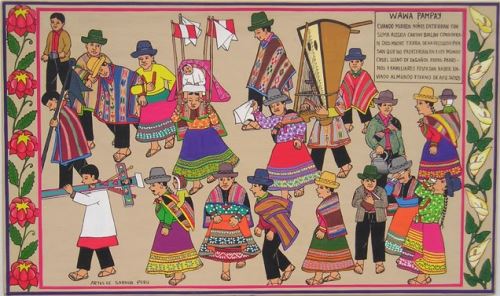
Las Tablas pintadas de Sarhua son una tradición cultural que se ha ido conservando durante varias generaciones en el pueblo de Sarhua de la provincia Victor Fajardo, en la región Ayacucho. Esta actividad económica es realizada por los pobladores hombres y mujeres con el propósito de salvaguardar la herencia, vida, uso y costumbres de la tradición familiar, antepasados y hechos importantes, constituyendo una herencia importante y una vía de comunicación como medio clave para ordenar la vida social del pueblo.
Las Tablas Pintadas de Sarhua poseen dos tamaños: las Tablas originarias que miden 2.5 metros y se utilizan como columnas de soporte de la viga principal del techo para una casa nueva, en esta se pintan escenas relacionadas a la genealogía familiar, los dioses tutelares y los santos católicos venerados por la familia. También suelen representar episodios de la historia familiar o momentos importantes del ciclo vital de su familia directa. Se acompañaban por textos breves escritos en quechua o español que identifican o comentan las escenas con un mensaje normativo o ejemplar.
Estas tablas grandes conllevan una ceremonia tradicional y ritual, son obsequiadas por los padrinos o compadres de techo a los dueños de casa. Los compadres recorren las calles cargando las tablas pintadas, acompañados de músicos, cantantes y botijeros que cargan los porongos de chicha de jora, quienes son recibidos por los dueños de casa con un banquete. A esta ceremonia de traslado se llama APAKUYKUY TABLE.Small boards appear from 1970 onwards, the traditional artists of Sarhua decide to paint boards in small formats less than 1 meter so that they can be marketed in artisanal markets. The transfer of tradition to small-format painted boards implied the conservation of the essence of their technique, changes in the design, materials used and, most importantly, they incorporated new allusive themes wherecommunal scenes shownsuch as festivals, customs and agricultural activities.
The technical process begins by adapting the wood, pasting it with plaster and, once dry, it is traced with a pencil. For painting, colored soils are used that are handcrafted on site, the pigments are found in the dyes of native plants (brown color is obtained), as well as cochineal (purple and pink color is obtained). The color black is obtained from the ashes; Currently, some workshops use anilines and temperas to give it greater attractiveness and diversity of color.
The painted boards of Sarhua have been declared Cultural Heritage of the Nation, and the town of Sarhua has also been declared by the Peruvian State as a “Charming Town” to promote tourism, its crafts and culture.
Wnglish
Painted boards of SarhuaThe painted boards of Sarhua are a cultural tradition that has been preserved for several generations in the village of Sarhua in the province of Victor Fajardo, in the Ayacucho region. This economic activity is carried out by the villagers, men and women, with the purpose of safeguarding the heritage, life, use and customs of the family tradition, ancestors and important events, constituting an important heritage and a means of communication as a key means to order the social life of the village.
The original Tablas, which measure 2.5 meters and are used as support columns for the main beam of the roof of a new house, are painted with scenes related to the family genealogy, the tutelary gods and the Catholic saints venerated by the family. They also often depict episodes from the family history or important moments in the life cycle of their immediate family. They are accompanied by short texts written in Quechua or Spanish that identify or comment on the scenes with a normative or exemplary message. These tables involve a traditional ceremony and ritual, and are given as gifts by the godfathers or compadres de techo to the owners of the house. The compadres go through the streets carrying the painted boards, accompanied by musicians, singers and ‘botijeros’ who carry the ‘porongos’ of chicha de jora, who are received by the owners of the house with a banquet. This transfer ceremony is called TABLA APAKUYKUY.
The small boards appear since 1970 onwards, the traditional artists of Sarhua decided to paint boards in small formats of less than 1 meter so that they could be commercialized in the artisan markets. The transfer of the tradition to the small format painted boards implied the conservation of the essence and changes in the design, and materials used. The most important thing they incorporated was new allusive themes such as festivities, customs and agricultural activities. The technical process begins by adapting the wood, and filling it with plaster. Once dry, it is traced with a pencil, colored pigments are used for the painting, which are handmade locally. The pigments are found in the dyes of the native plants (brown color is obtained), as well as from the cochineal (purple and pink color is obtained). Black color is obtained from ashes; Nowadays, some workshops use aniline and tempera to give more color and diversity of color.
The painted boards of Sarhua have been declared as Cultural Patrimony of the Nation, also the town of Sarhua has been declared by the Peruvian State as «Town with Charm» to promote tourism, its handicrafts and culture.
Valoraciones
No hay valoraciones aún.