
Descripción
El desarrollo del arte de tallado y escultura en madera en Bolivia tiene como uno de sus principales escenarios la región tropical de la Chiquitanía, en el Departamento de Santa Cruz. Los antecedentes de este arte se remontan a la elaboración de máscaras rituales por las poblaciones indígenas que habitaron la zona en tiempos prehispánicos. Pero, fue en la época colonial, con el establecimiento de las Misiones Jesuíticas, entre 1691 y 1760, que este arte alcanzó su máximo esplendor.
A su llegada, los jesuitas redujeron a la población indígena en pueblos con nombres cristianos: San Francisco, San Rafael, San José, San Juan, Concepción, San Miguel, San Ignacio, San Tiago, Santa Ana, Santo Corazón. Su trabajo misional consistía en dos objetivos: 1) Evangelizar a los indígenas y 2) “Civilizarles”, a través de enseñarles artes y oficios diversos. Una de estas artes fue la talla y escultura en madera. Bajo la tutela jesuita se construyeron imponentes iglesias con gran parte de su estructura en madera tallada de estilo barroco mestizo; así como del ornato sacro respectivo: retablos, púlpitos, cajonería de sacristías, sillas, confesionarios, atriles, etc., aprovechando la riqueza forestal de la región.
Con la expulsión de los jesuitas el año 1767 las iglesias entraron en un paulatino deterioro, hasta la década del 70 del siglo XX, cuando se comenzó la tarea de restauración de estas monumentales obras arquitectónicas. Este hecho significó un nuevo auge o el renacimiento de la talla y escultura en madera en la Chiquitanía, surgiendo hábiles maestros que ya no trabajan sólo con motivos religioso-cristianos, sino que pretenden recuperar en sus obras la identidad e historia regional. Todo esto con el apoyo de instituciones como el Centro para la Participación y el Desarrollo Sostenible CEPAD y la Agencia Española de Cooperación para el Desarrollo AECID, que promovieron cursos y talleres para la formación de artesanos talladores; aunque otros afirman que reaprendieron fácilmente este arte sin pasar cursos, porque llevan el talento y habilidad en la sangre.
Para el tallado y escultura en la Chiquitanía se utilizan diferentes tipos de madera: cedro, mara y roble que son livianas y fácilmente trabajables para hacer cuadros y obras de pequeño formato. También se emplea el cuchifor columns and other woods such assirari,paquióytajibothat are used for large sculptures. The tools used are: chainsaw to cut the wood, grinder to sand and for the carving work itself they use mallets, gouges, chisels and chisels.
The procedure begins with the selection and preparation (drying) of the wood; a design or drawing that must be embodied in wood; the carving itself, which is a manual job that can last a few days to several months, depending on the magnitude of the work; the finishing, which consists of sanding and the application of pigments, oils or varnishes, which also depends on the taste of the master carver, some prefer the natural color, others apply dyes to brighten the color of the wood and others perform a polychrome finish (mainly, when it comes to minor crafts); As for varnish, it is not always used by carvers, since they say it covers the porosity of the wood and does not allow it to breathe, affecting its durability over time.
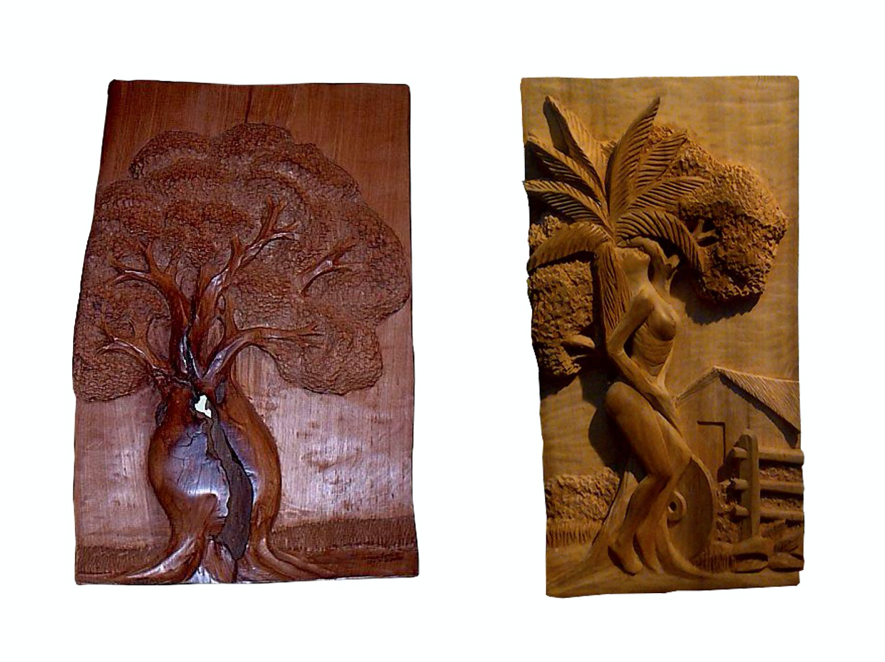
The motifs of Chiquitano carving and sculpture are diverse. Figures of a sacred nature, inheritance from the missionary era: angels, cherubs, saints, etc. Figures of a secular nature, emphasized from the 70s to date: fauna, flora, landscapes typical of the tropical environment of
the Chiquitanía; representations of the mythology and culture of local populations (legends, activities such as fishing, hunting, etc.). A variety of objects with utilitarian purposes are also made: spoons, napkin rings, skimmers, sugar bowls, coat racks, etc., and baroque furniture.
Elements such as colonial churches, music and, of course, the art of wood carving and sculpture, were the basis for UNESCO to declare the former Jesuit Missions asCultural Heritage of Humanityin 1991. Currently, the expressions that come from that missionary period are recognized as “living cultures” and constitute one of the pillars of the eastern identity of Bolivia, beyond its Andean region. The wooden works can be found in workshops and craft centers in the towns of Chiquitanía: San Javier, Santa Rosa, Concepción, San Ignacio de Velasco, San Miguel de Velasco, San Rafael, Santa Ana, San José; also in artisan stores in the city of Santa Cruz de la Sierra.
english
Wood carving and sculpture from the Chiquitanía in Santa Cruz.The development of the art of wood carving and sculpture takes place in the tropical region of Chiquitanía, in the Department of Santa Cruz. The history of this art can be traced back to the elaboration of ritual masks by the indigenous populations that inhabited the area in pre-Hispanic times. It was in colonial times, with the establishment of the Jesuit Missions, between 1691 and 1760, that this art reached its peak. Upon their arrival, the Jesuits reduced the indigenous population into villages with Christian names: San Francisco, San Rafael, San José, San Juan, Concepción, San Miguel, San Ignacio, San Tiago, Santa Ana, Santo Corazón. Their missionary work consisted of two objectives: 1) to evangelize the indigenous people and 2) to «civilize» them by teaching them various arts and crafts. One of these arts was wood carving and sculpture. Imposing churches were built with a large part of their structure in carved wood in the mestizo baroque style, as well as the respective sacred ornamentation: altarpieces, pulpits, sacristy boxes, chairs, confessionals, reading stands and more, taking advantage of the forest wealth of the region.
After their expulsion in 1767, the churches fell into gradual deterioration, until the ’70s of the 20th century, when the task of restoring these architectural works began. This meant the rebirth of carving and sculpture in the Chiquitanía, with the emergence of skilled masters who no longer worked only with religious-Christian motifs, but who sought to recover the regional identity and history in their works. All this with the support of institutions such as the Center for Participation and Sustainable Development CEPAD and the Spanish Agency for Development Cooperation AECID, which promoted courses and workshops for the training of artisan carvers.
Different types of wood are used for carving: cedar, mara and oak, which are light and easily worked to make paintings and small works. They also use «cuchi» for columns and other woods such as «sirari», «paquió» and «tajibo», which are used for large sculptures. It begins with the selection and preparation (drying) of the wood; the carving itself, which is a manual job that can take a few days or months, depending on the size of the work; the finishing, which consists of sanding and the application of pigments, oils or varnish, which also depends on the taste of the master carver, some prefer the natural colour, others apply dyes to enhance the color of the wood and others apply a polychrome finish; As for the varnish, it is not always used by the carvers, as they say that it covers the porosity of the wood and does not allow it to breathe, affecting its durability over time.
The motifs of carving and sculpture are diverse. They include figures of sacred art: angels, cherubs, saints, etc. There are also figures of a secular nature, emphasized from the 1970s to date: fauna, flora, landscapes and representations of the mythology and culture of the local populations. A variety of utilitarian objects are also made: spoons, napkin rings, skimmers, sugar bowls, coat racks, etc., and baroque furniture.
Elements such as colonial churches, music and the art of wood carving and sculpture were the basis for UNESCO to declare the former Jesuit Missions a World Heritage Site in 1991. Today, the expressions that come from this missionary period are recognized as «living cultures» and constitute one of the pillars of Bolivia’s eastern identity, beyond its Andean region.
The wooden works can be found in workshops and craft centers in the towns of Chiquitanía: San Javier, Santa Rosa, Concepción, San Ignacio de Velasco, San Miguel de Velasco, San Rafael, Santa Ana, San José; also in craft shops in the city of Santa Cruz de la Sierra.
Valoraciones
No hay valoraciones aún.