Descripción
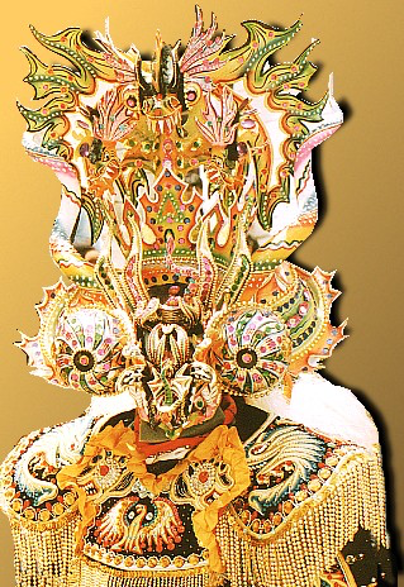
Las máscaras del Carnaval de Oruro, se constituyen en uno de los elementos esenciales de la danza icónica de este carnaval que es el único que se realiza por Fe y devoción a la Virgen de Candelaria, quién es la patrona protectora de Oruro.
Existen varias técnicas para hacer las máscaras del Carnaval de Oruro (Yeso, Latón, Esponja, Fibra de Vidrio, etc.), el yeso constituye el material más tradicional y combina más materiales a su vez. Aquí groso modo de la técnica de elaboración de máscaras del Taller de Máscaras “The QuirquinchoIt should be noted that this art constitutes a family legacy that is transmitted generation after generation.MATERIALS:
- And so
- Paintings
- Spotlights (light bulbs)
- Hats (felt)
- Mirrors
- Line
- Fabric (jute)
- Cardboard
- Brushes, etc.
MOLDS:
They are similar to shoe lasts, one part constitutes the neck and the other the face.
SHANK:
The hat felts are placed in the molds and covered with plaster. Once they dry, the contours are cut out and both pieces are sewn, then the holes are made that will serve as eyes and nose.
ACCESSORY PARTS:
They are the body of the dragon, its wings, horns of the mask, eyes, ears, etc.,
The lenses for the eyes, teeth and eyebrows are cut from the mask.
CHARACTERISTIC FEATURES OF THE MASK:
Around the nose there will be many pointed endings that resemble the flames of hell.
After the refining process, the mask is ready for painting.
The color combination always starts from the lowest tones to the darkest. It is then decorated with gold and silver tones with a verythin and long, also wave-shaped lines like veins on the ears, the dragon’s chest and on the wings.In this way one is ready to fulfill the desire or promise of dancing for the Virgen del Socavón on“The Carnival of Oruro”.
english
Masks of the Oruro CarnivalThe masks of the Carnival of Oruro are one of the essential elements of the iconic dance of this carnival, which is the only one that is performed for faith and devotion to the Virgin of Candelaria, who is the patron saint of Oruro.
There are several techniques to make the masks of the Carnival of Oruro (plaster, brass, sponge, fiberglass, etc.), plaster is the most traditional material and combines more materials at the same time. Here I outline the mask making technique of the «El Quirquincho» Mask Workshop. It should be noted that this art is a family legacy that is passed down from generation to generation.
MATERIALS:
Plaster, paints, spotlights, hats (felt), mirrors, glue, fabric (jute), cardboard and brushes.
MOLDS:
They are similar to shoe lasts, one part forms the back of the neck and the other the face.
FELT:
The hat felts are put into the molds and covered with plaster. Once they are dry, the contours are cut out and the two pieces are sewn together, then the holes are made to serve as eyes and nose.
ACCESSORY PIECES:
These are the body of the dragon, its wings, horns of the mask, eyes, ears, etc. The crystals are cut for the eyes, teeth and eyebrows of the mask.
CHARACTERISTIC FEATURES OF THE MASK:
On the contour of the nose, there will be many-pointed endings resembling the flames of hell. After the refining process, the mask is ready for painting. The color combination always starts from the lowest to the darkest shades. The mask is then decorated with gold and silver tones with a very fine and long brush, and also with wavy lines in the form of veins on the ears, the chest and the wings.
In this way, one is ready to fulfill the wish or promise to dance for the Virgin of the Socavón in the «Carnival of Oruro».
Valoraciones
No hay valoraciones aún.